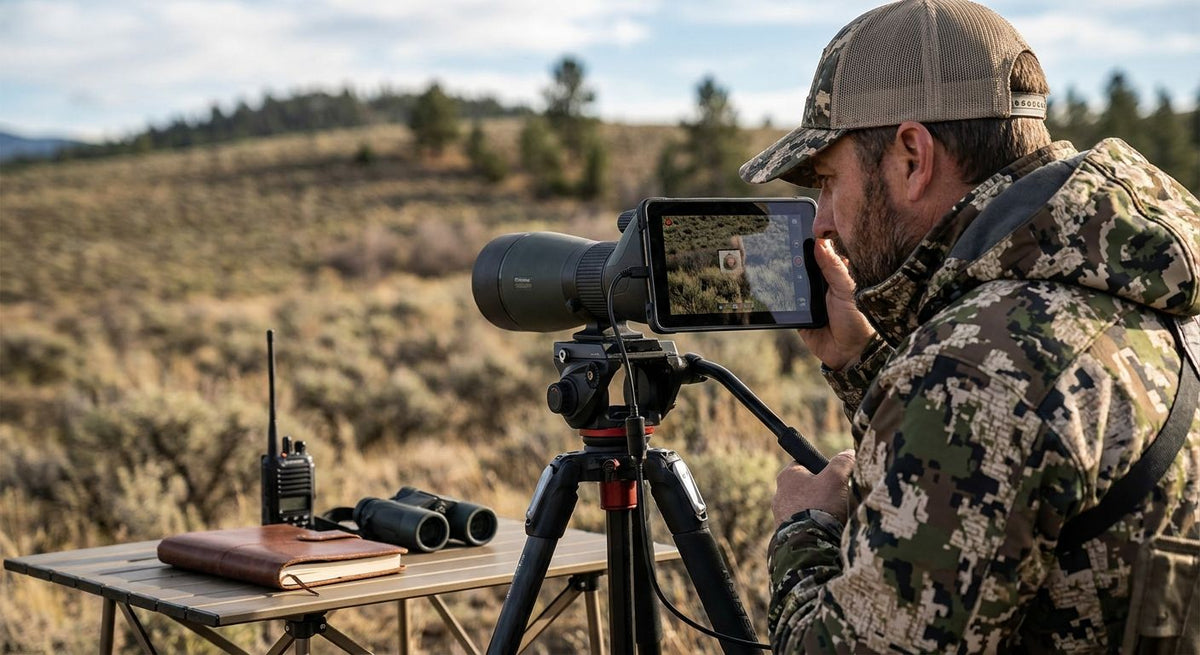
A digital spotting scope for hunting guides and outfitters has to do one job better than binoculars or a fixed scope ever could: confirm the hit, from your position, without walking a client's shot line across a canyon or a thousand yards of sage. This guide breaks down what actually matters for that job and which Longshot Cameras systems earn a spot in the truck.
- The Longshot HAWK is the entry-point digital spotting scope for hunting guides and outfitters at $299 with 12+ hour runtime -- Buy.
- For ranch-scale or multi-mile terrain, the Longshot RangerPlus is built for viewing impacts up to 2 miles out with no Wi-Fi or cell required -- Buy.
- Multi-camera kits like the LR-3 make sense for outfitters running more than one shooting station at once -- Consider.
- Skip phone-tethered optics that depend on cell signal -- most guide territory in 2026 still has dead zones.
Why this matters
Guides and outfitters lose paying hours walking downrange to confirm a hit, and they lose client confidence when a shot goes uncalled because nobody could see the impact from the truck or the glassing knob. A Hawk spotting scope camera or a longer-range Longshot setup solves both problems at once: the guide sees the hit in real time, on a tablet or phone, from the same spot they're already standing.
This matters more in 2026 than it did five years ago. Client expectations have shifted toward instant feedback -- nobody wants to squint through a spotting scope while a guide tries to talk them onto a target 400 yards off. A digital spotting scope for hunting guides and outfitters turns that guesswork into a live feed.
Who this is for
This guide is written for hunting guides, outfitters, and ranch managers who run multiple hunters or shooting stations across big, often cell-dead terrain -- the person calling shots for a client on a big-game hunt, running a sight-in day before a hunt, or managing a private range on the property. If you're guiding one rifle at a time on a small parcel with line-of-sight to the target, your needs are lighter than an outfit running four stations on a 3,000-acre lease.
What to look for in a digital spotting scope for hunting guides and outfitters
Range and glassing distance
An outfitter's terrain rarely matches a single yardage. You need a system that holds a usable image well past typical rifle scope range -- Longshot's camera line is built around viewing bullet impacts up to 2 miles from the shooting position, which covers everything from a 200-yard sight-in to a long-range confirmation shot.
No Wi-Fi or cell dependency
Most guide territory sits outside reliable cell coverage. A digital spotting scope that needs Wi-Fi or a data signal to function is a liability the moment you leave the lodge parking lot. Longshot cameras run without Wi-Fi or cell service, which is the single biggest differentiator against phone-based or app-only competitors.
Battery runtime for a full hunting day
A guide day starts before sunrise and often runs past legal shooting light. A camera that dies at hour six leaves you blind for the evening sit. The Hawk runs 12+ hours on a charge, which covers a dawn-to-dusk day without a mid-hunt swap.
Weatherproofing and field ruggedness
Guide gear gets rained on, dropped in truck beds, and packed on horses. Anything you put in front of a client needs to survive field handling, not just a bench test.
Setup speed across multiple stations
Outfitters running more than one shooter at a time need gear that goes from case to confirmed image in minutes, not a fifteen-minute fumble with an app pairing screen while a client waits.
Weight and portability
If the camera is going on a pack frame into the backcountry rather than staying at a fixed station, weight and case size decide whether it actually gets carried.
Top picks for hunting guides and outfitters
Longshot HAWK -- the entry point. Fits eyepieces between 36mm and 58mm, runs 12+ hours per charge, and pairs to iOS and Android for live HD video. It's the lightest, fastest-to-deploy option in the lineup and the right call for a guide running one station at a time. Verdict: Buy.
Longshot RangerPlus -- the long-range workhorse. Built for the terrain where a client's shot needs confirming from well beyond typical glassing distance, with the same no-Wi-Fi, no-cell design that makes it usable on leased ground with zero signal. This is the pick for outfitters covering big country in a single sit. Verdict: Buy for multi-mile properties; Consider if your longest confirmed shot rarely exceeds 400 yards.
Longshot LR-3 multi-camera kits -- the fleet option. Available as 2-, 3-, and 4-camera kits, this setup fits outfits running several shooting bays or stations simultaneously, so one guide can monitor more than one client's target from a single tablet. Verdict: Consider if you're running more than one active station; Skip if you're a solo guide with one client per hunt.
Longshot Marksman-1 -- the wildcard. Positioned for shooters who want a compact camera system without the full multi-cam footprint, it's a reasonable middle option between the Hawk and the larger kits. Verdict: Consider for guides who want more reach than the Hawk without stepping up to a full multi-camera kit.
Longshot external antenna -- the range extender. For outfits pushing signal distance past what the base unit handles reliably in rough terrain, adding an external antenna is the fix before assuming the camera itself is the problem. Verdict: Buy as an add-on once you know your terrain is stretching the base range.


What to avoid
- Phone-tethered optics that need cell data. They look identical to a real digital spotting scope in a store display, but the moment you're on leased ground with no bars, they're dead weight. This is the exact gap Longshot cameras are built to close.
- Heavy fixed tripod rigs meant for a bench, not a pack. A large tripod setup makes sense for a permanent range station -- it does not make sense strapped to a pack frame on a backcountry elk hunt.
- Single-camera systems for multi-station outfits. Running four hunters off one camera means someone is always waiting for a turn. If you run more than one bay, budget for a kit, not a single unit.
Verdict comparison
| Pick | Best for | Works without Wi-Fi/cell | Runtime | Verdict |
|---|---|---|---|---|
| Longshot HAWK | Solo guide, single station | Yes | 12+ hours | Buy |
| Longshot RangerPlus | Multi-mile terrain, single shooter | Yes | Full-day field use | Buy |
| Longshot LR-3 kits | Multi-station outfits | Yes | Full-day field use | Consider |
| Longshot Marksman-1 | Mid-range single-camera use | Yes | Full-day field use | Consider |
All four run without Wi-Fi or cell service, which is the deciding factor for most guide territory -- the differences come down to how many stations you run and how far your longest confirmed shot needs to reach.
See how the same logic applies to a related use case in the best gun camera for hunting breakdown, which covers single-hunter setups in more depth.
Watch a professional long-range training setup
Longshot’s Rob Furlong training video shows the pace and visibility demands that guides, instructors, and outfitters manage with shooters on the line.
Watch Longshot Cameras’ Rob Furlong Training, then use the checklist above to build a repeatable client setup.
FAQ
What is a digital spotting scope for hunting guides and outfitters?
It's a camera-based system, like the Longshot HAWK or RangerPlus, that lets a guide confirm a client's hit or miss from the shooting position instead of walking downrange. In 2026, most models pair to a phone or tablet over a private connection rather than cell data.
Does a Longshot camera need Wi-Fi or cell service to work?
No. Longshot cameras are built to run without Wi-Fi or cell service, which is the main reason they work on leased hunting ground or backcountry terrain with no signal.
How far can a Longshot target camera see a bullet impact?
Longshot systems are designed to view bullet impacts up to 2 miles from the shooting position, depending on the specific camera and terrain. Most guide and outfitter use cases fall well inside that range.
How much does a digital spotting scope cost in 2026?
The Longshot HAWK runs $299 new, with open-box units available for less. Multi-camera kits and longer-range systems cost more depending on how many stations you're outfitting.
How long does the battery last on a Hawk spotting scope camera?
The Hawk runs 12+ hours on a single charge, which covers a full guide day from before sunrise to last light without a swap.
Can one outfitter run multiple cameras across different shooting stations?
Yes. LR-3 multi-camera kits come in 2-, 3-, and 4-camera configurations built for exactly this -- multiple hunters or stations monitored from one tablet.
Is a digital spotting scope better than a traditional optical spotting scope for guiding?
For confirming hits at distance without walking downrange, yes -- a digital system puts the image on a screen the guide and client can both see, rather than one eye at a time through glass.
What accessory extends the range of a target camera in rough terrain?
An external antenna is the standard fix when a camera's base signal range gets stretched by terrain or distance, rather than replacing the camera itself.
One last thing
The detail most guides miss until their second season: the camera isn't the bottleneck, the signal path is. An outfit that skips the external antenna on a property with hills or heavy timber between stations spends more time troubleshooting dropped feeds than the camera itself ever costs to buy.
Share:
Best Rifle Cover for Hunting in 2026: Ranked Picks
Longshot Hawk Spotting Scope Camera: 2026 Guide