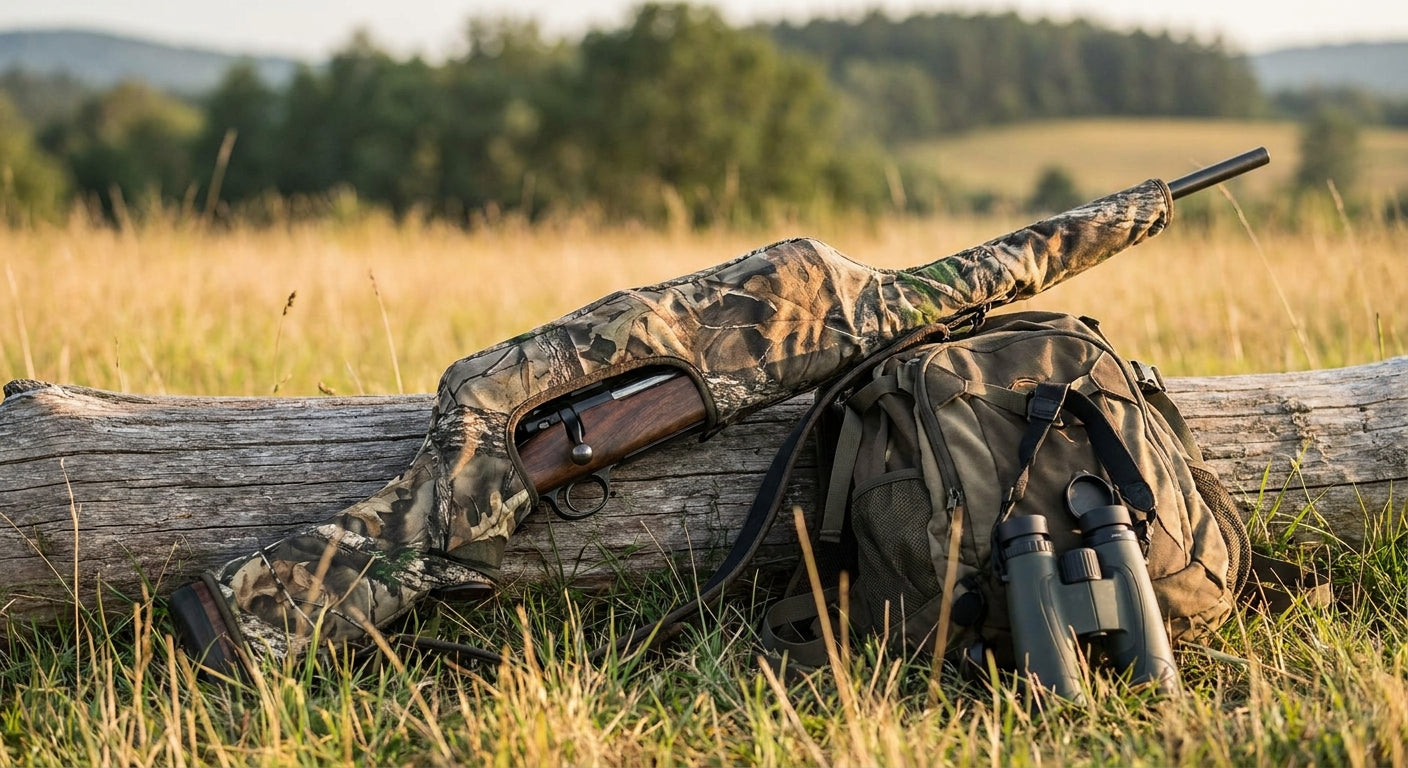
Field hunting puts a rifle through mud, rain, dust, and truck-bed rattling before a shot ever gets fired, and the right cover decides whether that rifle is ready or fouled when the moment comes. This guide ranks the cover types that actually hold up in field conditions for 2026, calling out where a generic case falls short of a hunting-specific design.
- The Longshot Rifle Cover wins for field hunting for $34.99 — keeps action dry and scope cool without adding bulk. Buy.
- Neoprene slip covers remain the most dependable all-weather choice for best rifle cover for hunting duty in 2026.
- Mesh covers trade weatherproofing for breathability — skip them for wet-climate field hunting.
- Silicone gun socks earn a Consider verdict for scoped rifles that need a fast, snag-free pull.
- Camo neoprene sleeves help with concealment in a blind but slow down a quick presentation in open country.
Why this matters
A rifle cover for field hunting isn't cosmetic gear — it's protection against the two things that actually wreck accuracy on a hunt: moisture working into the action and grit scratching the scope tube. Hunters who already rely on a target camera for hunters setup to confirm impacts without walking downrange know the same principle applies to gear care: a fouled rifle throws a shot long before a bad wind call does.
Field conditions in 2026 haven't changed much from prior seasons — rain still soaks an uncovered stock, and a truck bed still scratches a bare barrel — but the cover options have gotten more specific. Some are built for closet storage. Others are built to ride in a blind or a truck rack all day. This list only ranks the second kind.
How we ranked
Each cover type below is scored against four conditions that matter on an actual hunt, not a gun-safe shelf: weatherproofing in sustained rain, scratch resistance against truck-bed and blind hardware, snag-free removal when a shot presents itself, and pack weight for a multi-day hunt. A cover that wins on price usually loses on weatherproofing, and a cover that wins on protection usually adds bulk.
Verdicts reflect that trade-off directly instead of dressing it up. A Buy means the cover holds up across most field scenarios in 2026. A Consider means it's right for a specific climate or hunting style. A Skip means it looks like a fit but fails the field test for most hunters.
The ranked list
1. Longshot Rifle Cover — the built-for-the-field pick
The detail that matters most on the Longshot Rifle Cover is what it's actually built to do: keep a rifle cool under direct sun and dry when the weather turns, rather than just bagging it for transport. It's sized for a scoped hunting rifle instead of a bare long gun, which is the exact gap most generic covers leave open.
For a hunter who's in a blind before sunrise and packing out after dark, that's a cover doing its job without adding case-level bulk. Buy the Longshot Rifle Cover for 2026 field seasons where the rifle rides exposed more than it rides packed away.
2. Neoprene slip cover — the all-weather workhorse
Neoprene stretches over stock, barrel, and a mounted scope without a rigid shape underneath, and it sheds rain instead of absorbing it the way canvas does. That makes it the closest thing to a universal answer for wet, cold field conditions.
The trade-off is heat: neoprene traps warmth, which matters less in late-season hunts and more in early-season heat. Buy for fall and winter hunting where rain and cold are the bigger threat.
3. Silicone gun sock — the snag-proof minimalist
A silicone-treated gun sock slides on and off faster than neoprene because the material doesn't grip the stock the same way, which matters when a shot presents itself with no warning. It's lighter to pack and dries faster after a wet morning.
What it doesn't do well is stop water from reaching the action in a downpour — the fit is looser by design. Consider it for hunters prioritizing a fast pull over maximum weatherproofing.
4. Breathable mesh cover — the warm-weather compromise
Mesh covers exist to solve a heat problem: they keep dust and light debris off a rifle riding in a truck or ATV rack in hot, dry conditions without trapping warmth against the metal. For desert or early-season hunts, that airflow is the point.
The same mesh construction that breathes also lets rain straight through, so it's a poor match for anything but dry-climate hunting. Consider it only for hot, arid conditions, and Skip it anywhere rain is a real possibility.
5. Padded case-style cover — the truck-bed pick
A padded case-style cover is built more like a soft case than a slip cover, with foam lining that absorbs impact during truck-bed or ATV transport. It's the right call for hunters driving rough roads to reach a stand or blind.
Once you're on foot, the added padding turns into dead weight for no field benefit. Consider it for the drive in, but plan to swap to a lighter cover once you're hiking.
6. Camo neoprene sleeve — the concealment specialist
A camo-patterned neoprene sleeve does everything a standard neoprene cover does, plus it breaks up the rifle's outline in a blind or ground stand. For hunters sitting still for hours, that visual advantage is real.
The same pattern that helps concealment doesn't help speed — camo sleeves tend to fit tighter for a cleaner silhouette, which slows the pull. Skip it for spot-and-stalk hunts where a fast presentation matters more than concealment, and Consider it for blind hunting.
Comparison table
| Cover Type | Material | Weatherproofing | Best For | Verdict |
|---|---|---|---|---|
| Longshot Rifle Cover | Weather-resistant fabric | High | Blinds, truck racks, multi-day hunts | Buy |
| Neoprene slip cover | Neoprene | High | Cold, wet field conditions | Buy |
| Silicone gun sock | Silicone-treated fabric | Medium | Fast, snag-free pulls | Consider |
| Breathable mesh cover | Mesh/polyester blend | Low | Hot, dry climates | Consider |
| Padded case-style cover | Padded nylon | Medium | Truck bed and ATV transport | Consider |
| Camo neoprene sleeve | Camo neoprene | High | Blind hunting, concealment | Consider / Skip for spot-and-stalk |
Where to buy
- Buy direct from the manufacturer when rifle-specific fit matters — generic "long gun" covers rarely account for a mounted scope's ocular bell, which is exactly where a bad fit shows up first.
- Match the cover to the season you're hunting, not the discount on the shelf. A mesh cover on sale doesn't help in a rainstorm.
- Check whether a cover has any stated durability backing before buying an off-brand import version — a torn cover mid-hunt does the opposite of its job, right when it matters.
FAQ
What's the best rifle cover for hunting in 2026?
The Longshot Rifle Cover is the top pick for field hunting in 2026 because it's built specifically to keep a rifle cool under sun and dry through rain, not just to bag it for storage. Neoprene slip covers are the best generic alternative for cold, wet conditions.
Is a neoprene rifle cover better than a mesh cover for field hunting?
Neoprene wins for wet or cold hunts because it sheds rain instead of letting it through. Mesh wins only in hot, dry climates where airflow matters more than water resistance.
How much does a good rifle cover cost?
The Longshot Rifle Cover is priced at $34.99, which sits in the range most hunters pay for a hunting-specific slip cover. Generic mesh or neoprene sleeves land in a similar range but without the same sun and rain protection details.
Do rifle covers protect scopes too?
Covers sized for a scoped rifle, rather than a bare long gun, protect the mounted optic along with the stock and barrel. A cover cut only for a bare rifle leaves the scope exposed, which is the most common fit mistake hunters make.
Can a rifle cover fit a rifle with a bipod attached?
Slip-style covers sized for a full hunting setup, including optics, generally accommodate a folded bipod without extra tailoring. A tight case-style cover is more likely to require removing the bipod first.
Is camo necessary on a rifle cover for hunting?
Camo only matters for blind or ground-stand hunting where the rifle sits still and visible for long stretches. For spot-and-stalk hunting, a non-camo cover that pulls off faster is the better trade.
How long does a rifle cover last in field conditions?
A weather-resistant cover built for hunting, rather than general storage, holds up across a full season of truck-bed and blind use without the material breaking down. Cheaper mesh or thin nylon covers wear through faster under the same conditions.
Should I buy a padded case instead of a slip cover?
A padded case-style cover is the right call for the drive to a stand or blind over rough roads, since the foam absorbs impact a slip cover can't. Once you're on foot, a lighter slip cover like neoprene is the better field choice.
One last thing
Longshot Cameras built its name on target-monitoring systems that show bullet impacts up to 2 miles from the shooting position without needing Wi-Fi or cell service — the same hunters buying a rifle cover for field durability are often the ones checking zero at that kind of distance before the season opens. A cover that keeps moisture out of the action matters just as much when you're not walking downrange to confirm the shot; a fouled action ruins the confirmation before you ever see the hit.
Share:
Crossbow Camera for Hunting: Marksman Wins in 2026
Crossbow Camera for Hunting: Marksman Wins in 2026