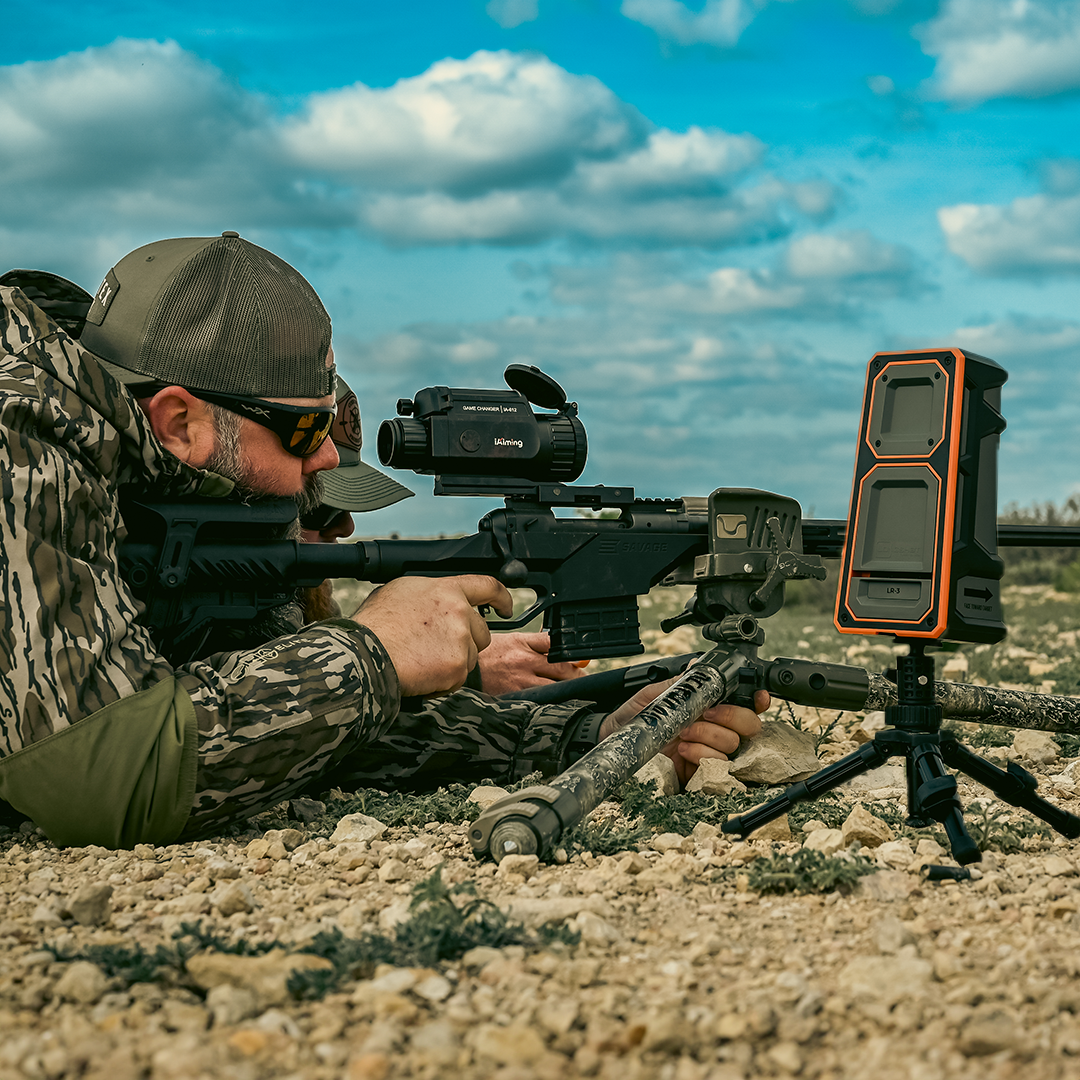
A target camera solves one of the oldest range problems: you fire a shot, but you cannot clearly see where it landed. Place the camera near the target and view every impact from the shooting position instead of waiting for a cease-fire and walking downrange.
- A Longshot camera shows bullet impacts on your phone or tablet.
- Ranger covers 100 yards; Marksman covers 300 yards; Ranger+ covers up to 1,000 yards.
- LR-3 carries a 2-mile guarantee for long-range and ELR shooting.
- Hawk adds the Longshot app to a compatible spotting scope at the firing line.
- No cell service or existing range Wi-Fi is required.
Why This Matters in 2026
A range day should be spent shooting, not walking back and forth to check paper. That problem gets worse as distance increases. Small bullet holes disappear through ordinary optics, heat and mirage soften the view, and every target check breaks your position and your train of thought.
Longshot offers downrange cameras from 100 yards to a 2-mile guarantee, plus Hawk for compatible spotting scopes at the firing line. In 2026, each option puts the target view on your phone or tablet without depending on the range’s internet connection.
The Problem a Target Camera Solves
When you cannot see a hit, you have three bad choices:
- Guess where the shot landed.
- Fire more rounds and hope the group becomes visible.
- Stop shooting and wait for the next cease-fire.
Guessing wastes ammunition. Extra shots can turn a clean target into a crowded one. Repeated walks downrange use time and force you to rebuild your position after every check.
A target camera removes the uncertainty. The camera looks at the target from a short distance, while your screen stays with you at the firing line. You see the target that is actually downrange, not a tiny version viewed across the full distance.
How Longshot Target Cameras Work
The basic 2026 setup has three parts:
- Place the camera near the target according to its instructions.
- Keep the receiver or viewing device at the firing line.
- Open the Longshot app to see the live target image.
Longshot systems create their own wireless connection. You do not need cell service, public Wi-Fi, or a monthly data plan to view the target.
Watch the official See Every Impact Instantly video to see the problem and solution in one range session.
What Changes at the Bench
You know where the shot landed
The first benefit is simple: you stop guessing. You can check the impact after a shot or string while the rifle, ammunition and conditions are still in front of you.
You make adjustments with better information
If a group is left, right, high or low, the target image gives you a clear reference. You can make one correction and confirm the result instead of chasing an impact you never saw.
You keep your shooting position
Walking downrange means getting out of the chair, moving away from the bench and setting up again. A target camera lets you stay with the rifle and keep the session organized.
You keep shooting during a live line
You still obey every range command. The difference is that you can view the paper during normal firing periods rather than waiting for the range to go cold just to learn what happened.
Choose the Longshot Camera That Fits Your Range
Every Longshot camera solves the same core problem—seeing shots without unnecessary walks downrange—but the right model depends on distance and how you want to view the target.
Ranger for up to 100 yards
The Longshot Ranger is the simple $229 choice for target viewing up to 100 yards. It connects to a phone or tablet, delivers a live 2MP view and is also suited to archery.
Choose Ranger for 100-yard rifle, pistol-caliber carbine or archery sessions when longer-range capacity is unnecessary.
Marksman for up to 300 yards
The Longshot Marksman starts at $499 and carries a 300-yard guarantee. It uses 2688 x 1512 imagery, lists 9+ hours of runtime and includes a camera, soft case, tripod and charger.
Choose Marksman for a dedicated downrange camera between 100 and 300 yards, especially when mirage makes spotting-scope viewing difficult.
Ranger+ for up to 1,000 yards
The Longshot Ranger+ is the compact $449 choice for target viewing up to 1,000 yards. It connects to a phone or tablet and keeps the target visible from the shooting position.
Choose Ranger+ when your normal range extends beyond 300 yards but stays at or below 1,000 yards.
LR-3 for up to 2 miles
The Longshot LR-3 starts at $999 and is built for long-range and ELR shooting. It carries a 2-mile guarantee, uses 2688 x 1512 imagery, lists 9+ hours of runtime and supports additional cameras.
The package includes the camera, receiver, hard case, two tripods and two chargers. Choose LR-3 when the range goes beyond 1,000 yards or you want a multi-camera-capable system.
Hawk for your spotting scope
The Longshot Hawk is the $299 firing-line option. It fits spotting-scope eyepieces from 36mm to 58mm, delivers 1920 x 1080 video, lists 12+ hours of runtime and adds Longshot app features without placing a camera near the target.
Choose Hawk when you already own a compatible spotting scope and want its view on a phone or tablet. Unlike Ranger, Marksman, Ranger+ and LR-3, Hawk’s useful distance depends on the spotting scope and conditions.


Quick Camera Comparison
| Camera | Best fit | Maximum distance | Current price |
|---|---|---|---|
| Ranger | Short-range shooting and archery | 100 yards | $229 |
| Marksman | Dedicated mid-range target viewing | 300 yards | From $499 |
| Ranger+ | Compact long-range target viewing | 1,000 yards | $449 |
| LR-3 | Long-range, ELR and multi-camera use | 2-mile guarantee | From $999 |
| Hawk | Compatible spotting scope at the firing line | Optic-dependent | $299 |
A Simple 2026 Range Workflow
1. Set the camera while the range is cold
Place the camera only when downrange access is authorized. Keep it outside the direct line of fire and follow the model instructions for distance from the paper.
Expected outcome: The full target fills most of the screen without cropping the edges.
Common mistake: Mounting too close and losing sight of shots outside the expected group.
2. Connect before you load
Join the Longshot network and open the app while the rifle is still safe. Confirm that the image is current and the target number matches your lane.
Expected outcome: The live target is visible before the first shot.
Common mistake: Connecting to another Longshot system on a busy range.
3. Fire a short string and look
Shoot the planned group, make the rifle safe and check the screen. Keep the review short so the camera helps the session instead of becoming a distraction.
Expected outcome: You can identify the group and decide whether an adjustment is needed.
Common mistake: Firing more rounds because the first impact was not checked.
4. Mark or save the result
The Longshot app can mark shots, save photos and record a session. Use a clear file name with the date, distance and rifle.
Expected outcome: You leave the range with a usable record, not an unlabeled picture.
Common mistake: Saving a tight zoom that hides the target scale.
What a Target Camera Does Not Replace
A target camera does not declare the range cold. It does not replace a spotter who calls wind or watches your position. It does not make a poor backstop safe.
The tool solves visibility and feedback. Range commands, firearm handling and downrange access remain unchanged in 2026.
FAQ
How can I see bullet impacts without walking downrange?
Use a Longshot target camera near the paper and view the live image on a phone or tablet at the firing line.
Which Longshot camera should I choose?
Choose Ranger for 100 yards, Marksman for 300 yards, Ranger+ for up to 1,000 yards, or LR-3 for its 2-mile guarantee. Choose Hawk to send a compatible spotting scope’s view to the Longshot app.
Does a Longshot camera need Wi-Fi?
No. Longshot systems create their own wireless connection and do not need existing Wi-Fi or cell service.
What is the best target camera for 1,000 yards?
Ranger+ is the compact choice for target viewing up to 1,000 yards and currently costs $449.
What is the best target camera beyond 1,000 yards?
LR-3 is the long-range choice with a 2-mile guarantee and current starting price of $999.
How is Hawk different from the target cameras?
Hawk mounts to a compatible spotting-scope eyepiece at the firing line. Its useful distance depends on the scope and conditions, while Ranger, Marksman, Ranger+ and LR-3 place a camera near the target.
Can I save pictures of my target?
Yes. The Longshot app can save photos, mark shots and record range sessions.
Does a target camera replace a cease-fire?
No. The camera only shows the target; all range commands and downrange-access rules still apply.
One Last Thing
The biggest gain is not the walk you avoid. It is the decision you make while the shot is still fresh. In 2026, Ranger, Marksman, Ranger+, LR-3 and Hawk give different shooters the same advantage: immediate target feedback from the firing line.
Share:
Target Camera for Shooting Alone Without a Spotter
Can’t See Bullet Holes at Long Range? | 2026