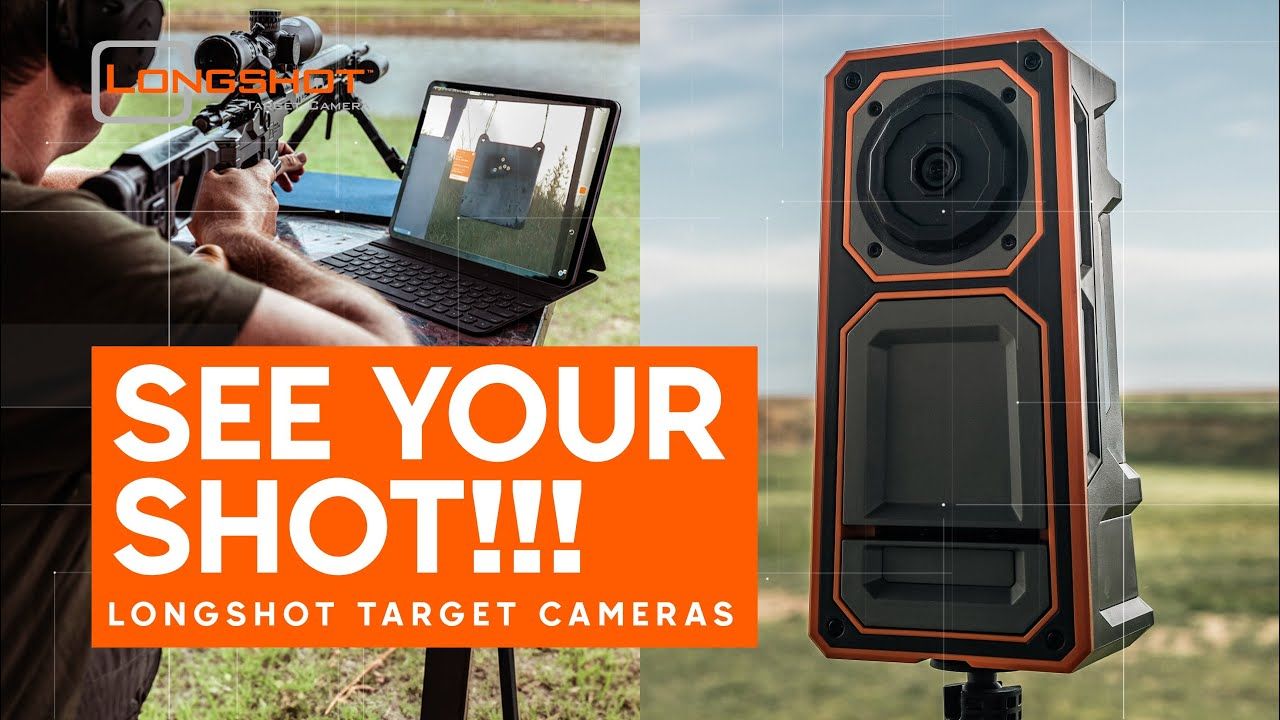
If you cannot see bullet holes at long range, the problem is often the viewing distance—not your eyesight or your spotting scope. A target camera moves the view close to the paper and sends the image back to your shooting position.
- A target camera sees the paper from close range instead of across the full shooting distance.
- Ranger+ covers target viewing up to 1,000 yards.
- LR-3 carries a 2-mile guarantee for long-range and ELR use.
- The live image appears in the Longshot app.
- No cell service or existing Wi-Fi is required.
Why This Matters in 2026
A spotting scope can be excellent and still fail to show a small hole through heat, mirage, poor light or a dark target. Magnification makes the target larger, but it does not remove the air between you and the paper.
A Longshot LR-3 target camera changes the geometry. The camera sits near the target, captures the paper at close range and sends the image to the receiver at the firing line. In 2026, that gives the shooter a direct view instead of forcing more magnification through the same conditions.
Why Bullet Holes Disappear
Distance makes a small mark smaller
A bullet hole is easy to see at arm’s length and hard to see hundreds of yards away. The target may fill the optic, but the impact still occupies a tiny part of the image.
Mirage moves the image
Heat rising from the ground bends and shifts the view. At long range, the target can appear to swim even when the optic is stable.
Paper and bullet holes lack contrast
A clean hit on white paper is easier to see than a hole in a black aiming point. Multiple impacts can merge into one dark area.
Light changes during the session
Backlighting, shadows and glare can hide a hole that was visible earlier. More magnification does not always restore contrast.
Tight groups become crowded
When rounds land close together, the newest impact can overlap an older hole. The question changes from “Did I hit?” to “Which hole is new?”
How a Target Camera Fixes the View
A target camera does not try to see through hundreds or thousands of yards of air. It starts close to the target.
For Marksman and LR-3, Longshot’s current guidance places the camera near the paper, generally 10 to 20 feet away depending on target size and framing. The camera sends that close view to your phone or tablet.
Watch the official Where Should You Place Your Longshot Target Camera? video for the 2026 placement process. A smaller target can use a closer camera position; a larger target needs more room in the frame.
What You See From the Bench
The full paper
Start wide enough to see the entire target and some surrounding backer. That protects you from losing a shot that lands away from the expected group.
Fresh impacts
The live feed updates as you shoot. You can review after each shot or after a planned string without leaving the firing line.
Group movement
If a scope correction moves the group, the target image shows the direction and amount on the same paper.
A saved record
The Longshot app can save photos and videos, mark shots and retain a session for later review. The target stops being a temporary view through glass and becomes a record you can compare.
Ranger+ for 1,000 Yards
The Longshot Ranger+ is the compact 2026 solution for target viewing up to 1,000 yards. The current Longshot site lists 1920 x 1080 resolution and a 6-hour battery.
Ranger+ costs $449 and includes the camera, receiver, USB-C cable and manual. It is the direct buy when your range stays inside 1,000 yards and you want a simple system that solves the visibility problem.
LR-3 for Long Range and ELR
LR-3 is the stronger choice when the target goes beyond 1,000 yards or the range plan demands more capacity. The current system carries a 2-mile guarantee, uses 2688 x 1512 imagery, lists 9 hours of battery life and can add more cameras.
LR-3 starts at $999 and includes a hard case, camera, receiver, two chargers and two tripods. For 2026 ELR shooting, that is the purpose-built option.


A Better 2026 Viewing Routine
Frame the full target first
Do not begin with a tight digital zoom. A wider view catches shots outside the expected group and shows the target scale.
Check the connection before shooting
Join the Longshot network and verify a live image before loading. The network does not provide internet, and that is normal.
Shoot a planned string
Fire one shot or a short group, make the rifle safe and check the target. Avoid filling the paper with extra rounds before you understand the first result.
Use Blinker on a crowded target
When the newest impact is hard to find, use the Blinker feature in the Longshot app. The official Lost Your Last Shot? Use the Blinker video shows the feature in a tight group.
Save the useful view
Save one full-target image and one closer group image. Name them with the date, distance, rifle and load so the files remain useful after 2026 range day ends.
What Not to Do
Do not keep adding magnification automatically
More power can make mirage and vibration more obvious. If the air is the problem, magnification cannot remove it.
Do not place the camera directly behind the aiming point
Keep the equipment adjacent to the target and outside the direct line of fire. Follow the model instructions and range rules.
Do not treat the screen as a range command
A quiet target image does not mean the line is cold. Downrange access still requires an authorized cease-fire.
Do not crop the paper too tightly
The shot you need to find is often the one outside the zoomed area.
FAQ
Why can’t I see bullet holes at 500 yards?
Distance, mirage, light and target contrast can hide small impacts even through good optics. A target camera solves this by viewing the paper from close range.
Will more spotting-scope magnification show bullet holes?
Sometimes, but magnification cannot remove mirage or poor contrast. A target camera provides a closer viewing position instead.
What target camera works at 1,000 yards?
Ranger+ is rated for target viewing up to 1,000 yards and currently costs $449.
What target camera works beyond 1,000 yards?
LR-3 is the long-range choice with a 2-mile guarantee and current starting price of $999.
How close should the camera be to the target?
Longshot’s current general guidance starts around 10 to 20 feet, adjusted for target size and the exact model instructions.
Can a target camera find a new shot in a tight group?
Yes. The Longshot app’s Blinker feature helps highlight the newest impact on a crowded target.
Does a target camera need cell service?
No. Longshot target cameras create their own wireless connection and do not need cell service or range Wi-Fi.
One Last Thing
The best optic is still looking through the atmosphere. A 2026 target camera starts on the other side of that problem. Put the lens near the paper, and long-range impacts become a clear image instead of a guess.
Share:
See Every Shot Without Walking Downrange | 2026
Zero Your Rifle Faster With a Target Camera | 2026