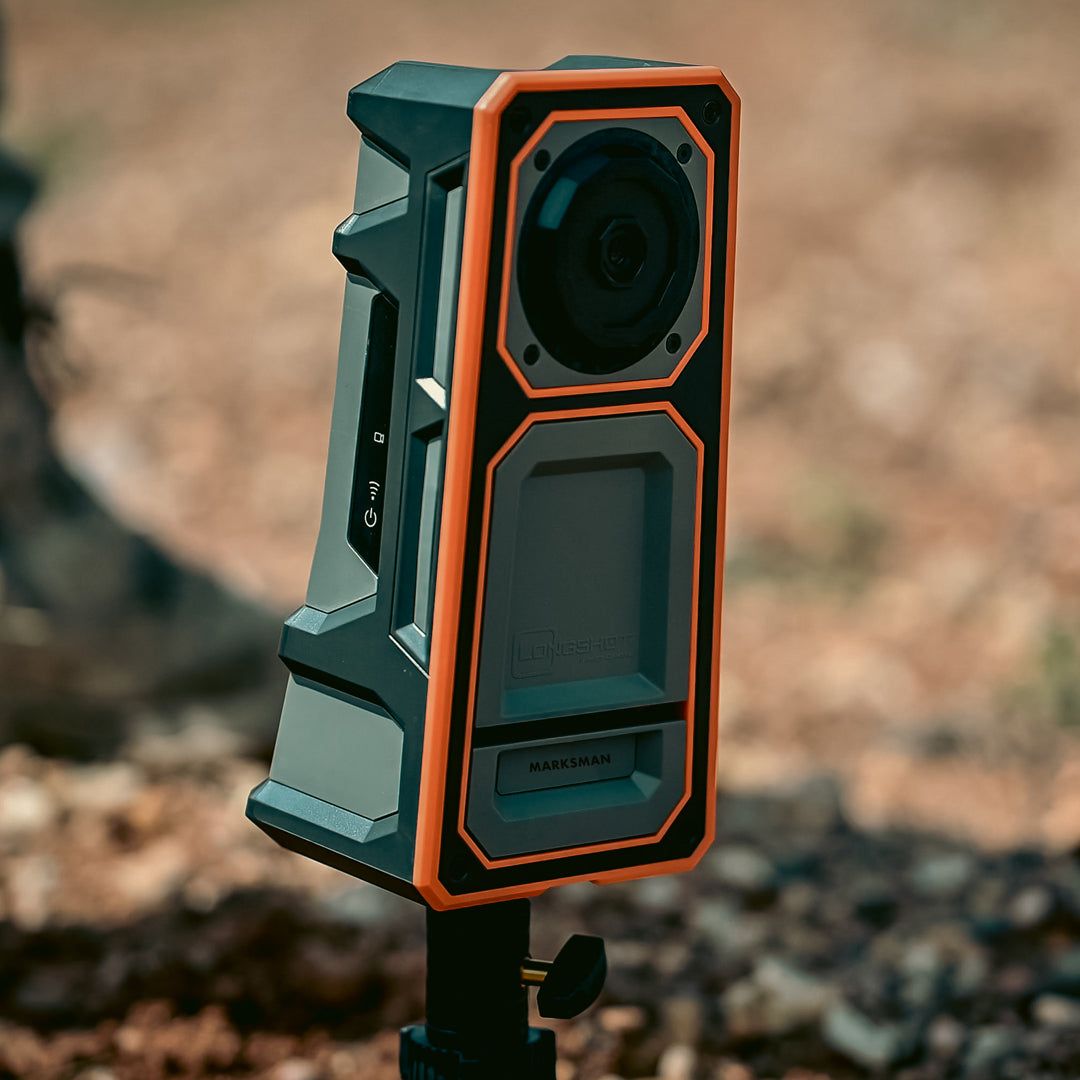
You do not need a second person behind a spotting scope to get useful feedback from every shot. A target camera places the view near the target and sends it back to your phone or tablet, so you can confirm impacts without leaving the shooting position after every string.
That changes a solo range session. Instead of breaking position, waiting for a cease-fire, walking downrange, and trying to remember which hole belongs to which shot, you can review the target while the rifle and your notes are still in front of you.
- A target camera gives a solo shooter a live target view on a phone or tablet.
- Longshot systems need no cell service or existing range Wi-Fi.
- Ranger+ is the compact pick for distances up to 1,000 yards.
- LR-3 is the long-range pick with a 2-mile guarantee and receiver-based link.
- A target camera never replaces a cease-fire or established range commands.
Why Solo Shooting Gets Inefficient
The hard part of shooting alone is preserving context between the shot and the target check.
A normal solo cycle often looks like this:
- Fire a short string.
- Put the rifle in a safe condition.
- Wait for the range to go cold.
- Walk to the target.
- Inspect or photograph the group.
- Walk back and rebuild the position.
- Try to connect each impact with the note you wrote several minutes earlier.
That process works, but it introduces delay and inconsistency. Your position changes. Wind conditions move. The barrel cools. The sight picture you were evaluating is no longer immediate.
A downrange target camera shortens the feedback loop. You still follow every range command, but you can inspect impacts during live-fire periods without walking forward. That is especially useful when the goal is to confirm zero, compare loads, track cold-bore placement, or diagnose a group that opened unexpectedly.
For an owner’s view of how remote target monitoring changes a long-range session, read Reflections of an ELR Camera User.
What a Solo Shooter Should Look For
Range that matches the actual target distance
Do not buy range you will never use, but do not choose a system that leaves no margin. Longshot’s current lineup covers distinct use cases:
- Ranger: up to 100 yards.
- Marksman: 300-yard guarantee.
- Ranger+: up to 1,000 yards.
- LR-3: 2-mile guarantee.
- Hawk: a spotting-scope camera for shooters who already own compatible glass.
The Ranger and Ranger+ use compact camera formats. The Marksman and LR-3 are downrange systems designed to sit 15–20 feet behind the target. The Hawk fits spotting-scope eyepieces from 36mm to 58mm.
A connection that does not depend on the facility
Many outdoor ranges have weak cellular service, no public Wi-Fi, or both. Longshot target cameras create the connection used by the camera, receiver, and viewing device. No cell or existing Wi-Fi service is required.
That matters when you shoot alone because there is no second person to troubleshoot while you stay on the rifle. Charge the system, pair it before the trip, and keep the connection process simple.
A way to preserve the session
A live picture is useful. A saved record is better. The Longshot app can mark and number shots, save photos, review sessions, and record video or stills. Those features let one shooter keep a clean sequence without relying on memory.
Watch the official See Every Impact Instantly video to see the Longshot workflow in action. Ranger+ keeps the system compact for target viewing up to 1,000 yards; LR-3 adds a receiver-based link, 2688 x 1512 imagery, 9+ hour runtime, and a 2-mile guarantee for long-range and ELR sessions.
For setup, use the official Longshot app tutorial before the first range trip. Also review Where to Place Your Target Camera so the lens is close enough for a clear target view but not directly behind the target face.
A Practical Solo-Shooting Workflow
1. Build the range plan before loading the vehicle
Write down the distances, targets, expected number of strings, and the specific question each string should answer. Examples include:
- Confirm the first cold-bore shot relative to the group center.
- Verify a 100-yard zero before moving to 600 yards.
- Compare two loads without mixing their impacts.
- Check whether a turret correction moved the group by the expected amount.
Bring the camera, receiver if your system uses one, phone or tablet, chargers, tripods, target backers, and a paper or digital shot log.
2. Charge and pair at home
Power every component on before the trip. Confirm the viewing device joins the correct Longshot network and opens the live feed. If several Longshot systems will be on the same firing line, label your components and note the network name.
The Longshot Tablet is available as an 11-inch Android device programmed with the app and video tutorials. When ordered with a camera system, Longshot can pair the devices for a turn-key setup.
3. Place the camera deliberately
Position the downrange camera according to the product instructions, generally adjacent to the target and back far enough to frame the target clearly. Keep it out of the direct line of fire and protected from likely splash, fragments, and target movement.
Aim the lens squarely at the target, then check the feed from the firing line before shooting. A stable tripod matters more than a perfect-looking setup. If wind can move the camera, lower the legs, widen the stance, and add weight only where the tripod manufacturer permits it.
4. Establish a naming rule
Name the session before the first shot. A useful format is:
2026-08-28 | Rifle | Load | Distance | Conditions
The point is not the exact format. The point is being able to find the session later and know what it contains.
5. Mark impacts in real time
Fire the planned string, then use the app to identify impacts. Number shots when sequence matters. Save a clean still before covering the target with too many marks.
Longshot’s official Blinker Shot Locator demonstration shows how the app helps draw attention to a new impact. Use that visual cue as a confirmation tool, then compare it with the full group and your shot notes.
6. Keep shooting and analysis separate
Do not turn every shot into a long screen session. For most drills, fire the planned string, make the rifle safe, then review the group. The camera should reduce disruption, not create a new distraction.
If an impact is missing, check the entire target before changing the rifle. A missed call, target-frame hit, or impact outside the current zoom area can look like an equipment problem when it is not.
Choosing the Right Longshot Setup


Ranger+ is the best fit for most solo rifle shooters who want one compact system for distances up to 1,000 yards. It connects to a phone or tablet and keeps the target visible without a separate firing-line receiver. Choose LR-3 when long-range or ELR shooting is the priority. Its receiver-based system, 2-mile guarantee, 2688 x 1512 imagery, 9+ hour runtime, hard case, two tripods, and two chargers make it the purpose-built option for demanding distance.
A Hawk is different: it mounts to a compatible spotting scope rather than sitting near the target. That can be the right answer when range rules do not permit downrange electronics or when one optic must cover several targets from the firing line.
Mistakes That Waste a Solo Range Day
Arriving with untested connections
Pair at home. A five-minute check on the workbench prevents a long troubleshooting session on a crowded firing line.
Zooming too tightly before the first shot
Leave enough target visible to catch a shot outside the expected group. Tighten the view after zero is confirmed.
Mixing notes from several targets
Use one session name and one target label. Photograph the physical target number if the range uses numbered frames.
Treating the screen as a safety authority
The camera does not tell you that the range is cold. Only the rangemaster or established range procedure does that. Never go forward because the feed appears quiet.
Changing several variables at once
If you adjust the scope, load, rest, and position together, the target camera records the result but cannot tell you which change caused it. Run one controlled question per string.
FAQ
Can a target camera replace a spotter?
A target camera can handle impact viewing and documentation for a solo shooter. It does not call wind, watch your position, or provide a second safety observer.
Does a Longshot target camera need cell service?
No. Longshot target camera systems create their own wireless connection and do not require cell service or an existing Wi-Fi network.
Should a solo shooter choose Ranger+ or LR-3?
Choose Ranger+ for a compact $449 system covering target viewing up to 1,000 yards. Choose LR-3 from $999 when you need a receiver-based system with a 2-mile guarantee for long-range or ELR shooting.
Which Longshot model fits a 600-yard range?
Ranger+ fits a 600-yard range because it supports target viewing up to 1,000 yards. LR-3 is the longer-range option with a 2-mile guarantee and receiver-based link.
What comes with the LR-3?
The LR-3 includes the camera, receiver, hard target-camera case, two tripods, and two chargers. Its current product page lists 2688 x 1512 imagery and 9+ hours of runtime.
Can I save the target image after the session?
Yes. The Longshot app supports saved photos, stills, video, shot marking, and session review.
Is a target camera safe beside the target?
Place the camera according to its instructions and outside the expected line of fire. No location eliminates all risk from misses or fragments, so follow the range’s equipment rules.
Make Every Walk Downrange Count
Shooting alone does not have to mean guessing between cease-fires. A properly placed target camera keeps the target visible, preserves the shot sequence, and lets you make decisions while the rifle, conditions, and notes are still in front of you.
Start with a charged, paired system and one clear goal for the session. The result is fewer unnecessary walks, cleaner data, and more useful rounds downrange.
Share:
shogun-title-probe
See Every Shot Without Walking Downrange | 2026