
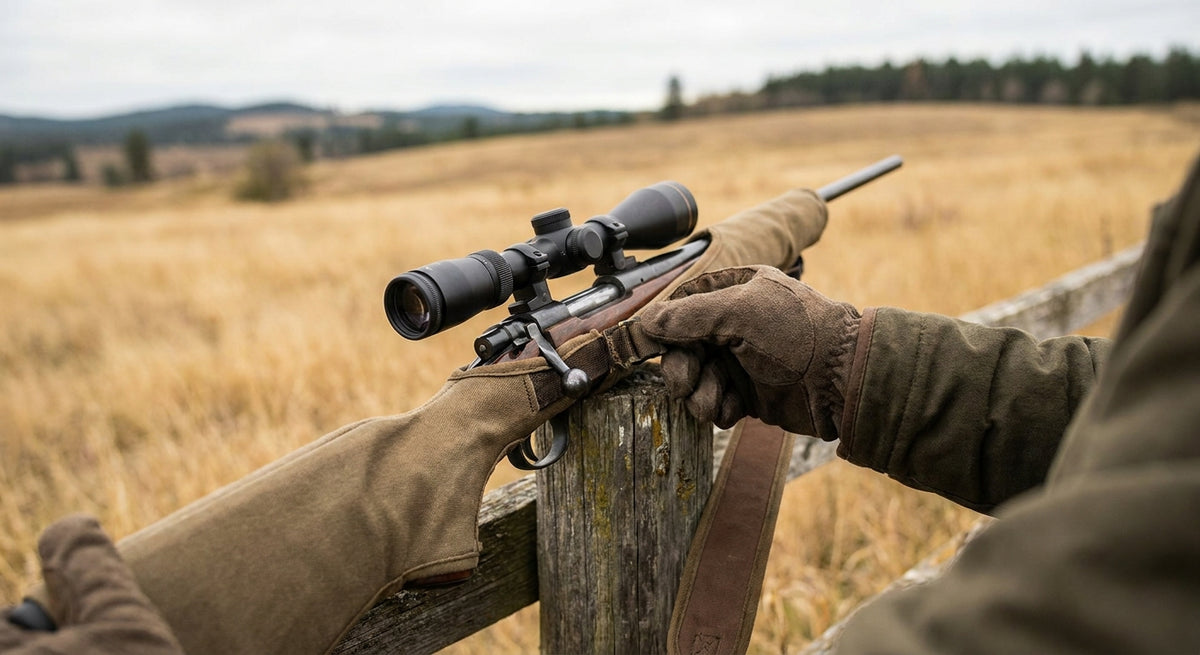
Rain, dust, and brush don't care how much you spent on your rifle — a rifle cover is the cheapest insurance you'll buy for a field gun, and most hunters put it on wrong.
- The Longshot Rifle Cover ($34.99) blocks sun and rain without adding bulk to your rifle in the field. Buy.
- Cover the optic and action first, muzzle last, to protect glass and the chamber from moisture.
- Neoprene seals better than nylon when you're covering a rifle in wet 2026 field conditions.
- Store a covered rifle muzzle-down whenever you can to keep water out of the bore.
- Uncover the muzzle last and check for debris before you ever chamber a round.
Why this matters
A rifle left uncovered in the truck bed or blind takes a beating you don't notice until you're at the bench trying to figure out why your groups opened up. Sun bakes stock finish and can warp synthetic material over a season. Rain gets into scope turrets, bolt raceways, and the crown of the muzzle — all places where a $34.99 rifle cover would have kept things dry.
Hunters who use a rifle cover in the field aren't babying their gear — they're protecting the same zero they spent range time dialing in. If you've already invested in getting your load and your optic dialed with a target camera, covering the rifle between stalks is the last step that protects that work.
What you'll need
- A rifle cover sized to your rifle length, with the optic and action already mounted
- A dry rag or microfiber cloth for wiping down the action and glass before covering
- Silicone grease or a light coat of oil for exposed metal (bolt face, muzzle threads)
- A sling or carry strap that clears the cover's closure
- 5 minutes at the truck or trailhead before you start walking
The steps
1. Wipe the rifle down before you cover it
Moisture trapped under a cover does more damage than moisture in open air, because it can't evaporate. Run a dry rag over the stock, action, and glass before the cover goes on — this takes 30 seconds and prevents condensation from sitting against blued steel overnight. Skipping this step is the single most common mistake hunters make with a rifle cover: they seal in the humidity from a sweaty morning hike.
2. Cover the optic and action first
Your scope glass and the action's internal parts are the highest-value real estate on the rifle, so they go under cover first. Slide the cover from the receiver forward, seating it snugly around the scope bell and turret housing before you work toward the muzzle. A cover that's loose around the optic lets rain wick in exactly where you need it to stay out.
3. Secure the muzzle end last
Work the cover down to the muzzle and cinch the closure so wind doesn't work it loose on a ridge walk. Leave a half-inch of slack at the crown rather than pulling the fabric tight against it — direct pressure on the crown from a stiff cover can, over months, dent soft material into the rifling. This is a 2026-specific concern with polymer-blend covers that stiffen in cold weather.
4. Store the rifle muzzle-down whenever possible
Gravity is doing you a favor if you let it. A muzzle-down rifle sheds any water that gets past the cover instead of pooling it against the action or bolt face. In a blind or truck rack, angle the muzzle toward the ground; on a pack, let the barrel hang low rather than up.
5. Check the seal after sustained rain
Covers rated for field use hold up to steady rain, but a downpour that lasts hours can push water past a seam if the closure has loosened. Reach under the cover at the action every hour or two during a wet sit and feel for dampness. Catching it early means a quick wipe-down instead of a rust spot by evening.
6. Uncover the muzzle last, before you shoulder the rifle
When it's time to shoot, pull the cover back from the muzzle first and check the bore for anything that worked its way in — leaves, condensation, dust. A blocked or wet bore changes point of impact on the first shot, which defeats the entire purpose of protecting the rifle in the first place. Then clear the action and optic before you finish removing the cover.
Troubleshooting
- Cover keeps sliding off the muzzle on long walks — the closure is too loose; cinch it one notch tighter and check it at each stop rather than assuming it holds.
- Condensation forms inside the cover overnight — you covered a wet or sweaty rifle; always wipe down and let the metal cool before covering it in a warm truck or tent.
- Cover material feels stiff and cracks in cold weather — nylon and cheap polymer blends lose flexibility below freezing; a neoprene cover stays pliable through a 2026 late-season cold snap.
- Optic turrets get bumped when the cover goes on — you're forcing the cover instead of rolling it, catching the turret caps; roll the cover from the action forward instead of pulling it straight over.
- Cover smells musty after storage — it was packed away damp; always dry a rifle cover fully before folding it into a range bag or safe.
Tools and resources
- Rifle cover — the field-ready cover referenced throughout this guide, sized for scoped bolt-action and precision rifles
- A Ranger target camera setup if you're already running remote impact-viewing gear alongside your rifle in the field
- A dedicated rifle bag or case for transport between the truck and the stand, used in addition to — not instead of — a field cover
- Silicone-based gun oil for metal surfaces that see repeated cover-on, cover-off cycles
What to do next
Once your rifle is covered correctly in the field, the next gap most hunters and long-range shooters overlook is verifying impacts without walking downrange every time you dial a new load. If you're spending real time in the field or at the range dialing zero, read the guide on target camera for hunters to see how remote impact-viewing changes the number of trips you make to the target and back.
FAQ
What's the best rifle cover for field hunting?
A neoprene or polymer-blend cover sized to fit a scoped rifle without pressing on the muzzle crown is the best choice for field hunting in 2026. The Longshot Rifle Cover runs $34.99 and fits standard bolt-action rifles with a mounted optic.
Do I need a rifle cover if I already use a scope cover?
Yes — a scope cover only protects the optic, not the action, bolt, or muzzle crown. A full rifle cover protects every exposed part of the gun, which matters most in rain or heavy dust.
How much does a rifle cover cost in 2026?
Field-ready rifle covers cost $25 to $45 in 2026 depending on material and fit. Neoprene covers sit at the higher end of that range but hold up better in wet or cold conditions.
Can a rifle cover go on with a mounted scope and bipod?
Yes, a properly sized rifle cover fits over a mounted scope, and most designs accommodate a folded bipod without forcing the fabric. Check the cover's fit around the scope bell before you buy if your optic has an oversized objective lens.
Is neoprene or nylon better for a rifle cover?
Neoprene stays flexible in cold weather and seals tighter against rain than nylon. Nylon is lighter and dries faster, which makes it a better fit for warm, dry climates rather than wet or freezing field conditions.
How do I keep a rifle cover from rattling in the wind?
Cinch the closure at both the action end and the muzzle end so there's no loose fabric for wind to catch. A cover that rattles is almost always sized too large for the rifle it's covering.
Can I leave a rifle cover on while it's in a hard case?
Yes, but dry the rifle and the cover fully before closing the case. A damp cover sealed inside a hard case traps moisture against the metal longer than open air ever would.
Does a rifle cover work for both bolt-action and AR-platform rifles?
Most field rifle covers are cut for bolt-action profiles with a raised scope and narrow forend. AR-platform rifles with wider handguards or foregrips need a cover specifically sized for that profile to avoid a loose, wind-catching fit.
One last thing
The part of the rifle that gets missed most in the field isn't the barrel — it's the muzzle crown, and a cover that presses fabric flat against it under tension can leave a mark over a season of use that shows up as a flyer at 600 yards. Leave that half-inch of slack at the muzzle every time you cover the rifle in 2026, and you'll never trace a bad group back to the cover instead of the shooter.
Share:
Target Camera for Range Safety Officers | 2026
Cant Rod for Rifle: 2026 Leveling Guide — Buy Verdict