Cant that goes unnoticed on the line shows up on the target three shots later — and by the time you're chasing it with dope corrections instead of a level bubble, you've burned a stage or a magazine of factory ammo.
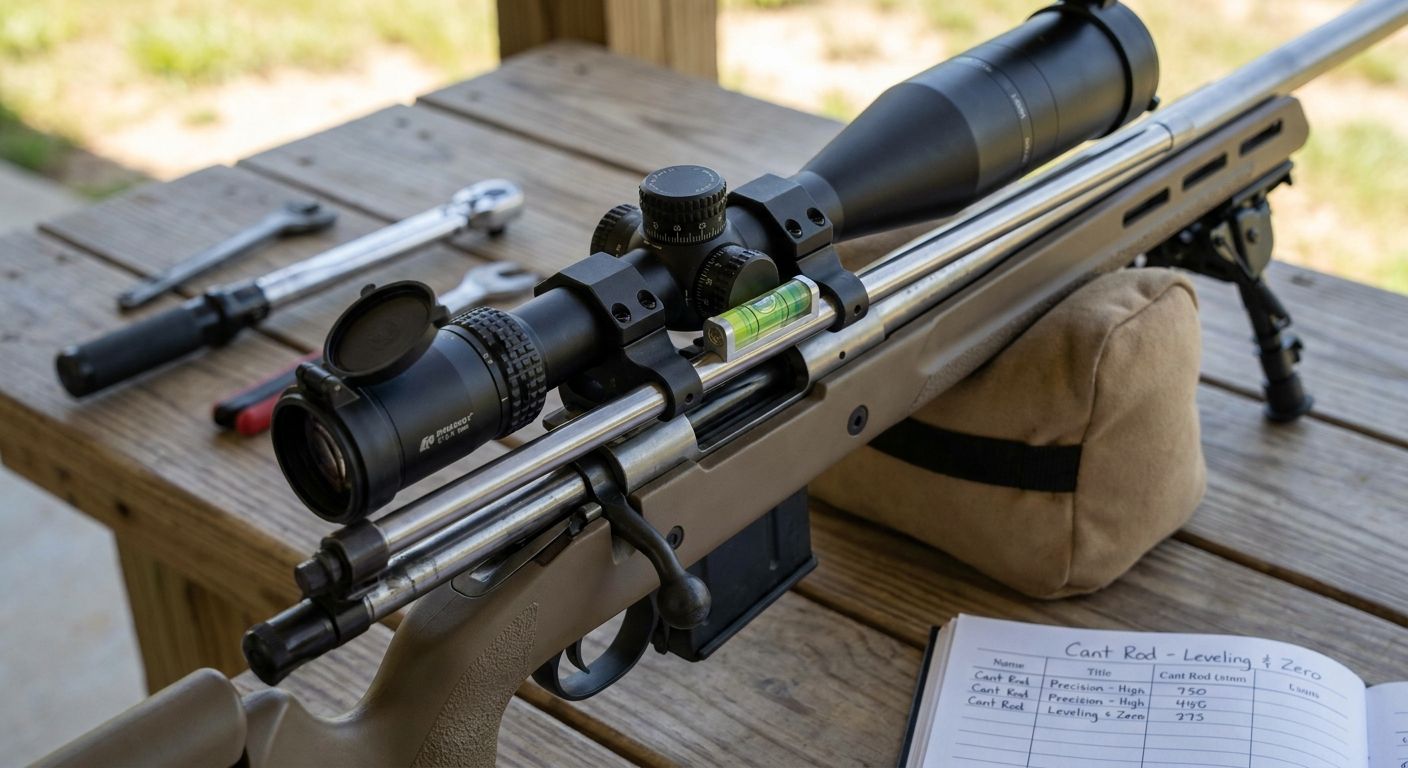
- The Longshot Cant Rod ($84.99) is the pick for PRS, NRL22, and F-Class shooters who need a repeatable cant check before every stage or string. Buy.
- Cant error scales with bullet drop, not just the tilt angle, so it costs more at 800-1,000 yards than it does at 100.
- Pair a cant rod for rifle setups with a fixed rest and a stable base so you're removing one position variable at a time, not guessing at three.
- Skip stick-on bubble levels with no rail index — they read differently every time you remount them mid-match.
Why this matters
Cant error is a physics problem dressed up as a shooter problem. Tilt a rifle a couple of degrees off vertical and the scope's crosshair still looks centered on the target, but the bullet's drop now has a horizontal component it didn't have before. The farther the bullet falls, the more that tilt costs you — which is exactly why PRS stages built around 300 to 800 yards and F-Class matches stretching to 1,000 yards punish cant so much harder than a 100-yard zero session ever will.
A cant rod solves this before the shot, not after it. It gives you a repeatable, mechanical read on level instead of a guess from your inner ear, which is notoriously bad at detecting slow tilt once you're locked into a position. In 2026, with more shooters tracking dope in apps and reviewing impacts on target cameras from the firing line, cant is the one variable that still gets solved the old-fashioned way: a physical level, checked every time.
Who this is for
This guide is for precision rifle shooters who've already tightened their ammo, their optic, and their rest — and are now hunting the last few tenths of drift in their group. That's PRS and NRL22 competitors dialing multiple stages a match, F-Class shooters holding a called zero across 20-shot strings at 1,000 yards, and long-range hunters who need their first shot to land where the dope says it should, not a foot to the side of it. If you're still grouping inside 2 inches at 100 yards, cant isn't your bottleneck yet — fix that first.
What to look for in a cant rod for rifle leveling
Repeatable read, not just a level bubble
A level that reads true once but drifts the next time you remount it is worse than no level at all, because it teaches you false confidence. The value of a cant rod for rifle work is in the repeat: same read, same rifle, same position, every single time you check it.
Mount compatibility with your action or rail
Some cant tools clamp to a scope tube, others index off a Picatinny rail or an action flat. Rail-mounted designs generally hold their zero-reference better across a match day because they're referencing the receiver, not a tube that can rotate slightly in its rings.
Field durability across a full match day or hunt
A tool that lives in a pack through mud, rain, and a truck bed needs to survive drops and temperature swings without losing its calibration. This matters more for hunters and match shooters moving position to position than for a bench shooter checking once and leaving it alone.
Setup speed at the line
A cant check that takes 30 seconds per stage is a habit. One that takes three minutes gets skipped under a stage clock — and the shot you skip it on is the one where it mattered.
Pairing with a fixed rest for a repeatable position
A cant rod only protects you from tilt if your rest is holding still underneath it. Bag height, tripod stability, and rail mounting all interact with how consistently your rifle sits level shot to shot.
Compatibility with remote zero verification
If you're already running a target camera to check impacts without walking downrange, a leveled rifle and a verified impact are two halves of the same diagnostic. One tells you the rifle was square when you fired; the other tells you where the bullet actually landed.
Top picks
The anchor pick — Longshot Cant Rod. This is the one tool in this guide actually built to solve cant, and at $84.99 it's priced as a one-time setup cost, not a consumable. It's built for shooters who need a mechanical, repeatable read before every string rather than a guess based on feel. Buy — this is the piece that makes the rest of the list relevant.
The stable base — Large Tripod. A cant check means nothing if the platform underneath the rifle isn't holding its position between shots. A heavier, taller tripod gives you a fixed reference point you can return to stage after stage instead of resetting your whole position from scratch. Buy for match shooters running multiple positions in a single day.
The consistent rest — Bag Riser. Bag height is one of the quiet variables that changes your natural point of aim, which then makes it harder to trust a cant read because your whole position shifted, not just the rifle. A riser locks that height in so the cant rod is measuring the rifle, not compensating for a different body position every time. Consider — worth adding once you've confirmed the cant rod and tripod are dialed in.
What to avoid
- Stick-on bubble levels with no rail index. They look identical to a real cant tool but they reference the scope tube, which can rotate a degree or two in its rings without you ever noticing.
- Eyeballing cant off a reticle level line only. A reticle level is a rough visual check, not a repeatable measurement — fine for casual range days, not for a match where a called zero has to hold across a 20-shot string.
- Any cant tool you can't mount the same way twice. If reseating it changes the read by more than a hair, it's not giving you data — it's giving you noise with extra steps.
Verdict comparison
| Tool | Best for | Mounts to | Verdict |
|---|---|---|---|
| Longshot Cant Rod | PRS, NRL22, F-Class stages | Picatinny rail / action | Buy |
| Large Tripod | Fixed reference point across positions | Ground / bench | Buy |
| Bag Riser | Consistent bag height under the stock | Shooting bag | Consider |
FAQ
What is a cant rod used for on a rifle?
A cant rod checks whether your rifle is tilted left or right of true vertical before you fire. Even a slight tilt shifts bullet impact horizontally at distance, so shooters use it before every shot or stage in 2026 competition and long-range setups.
How much does a cant rod for a rifle cost?
The Longshot Cant Rod runs $84.99 at current 2026 pricing. That's a one-time setup cost rather than a recurring expense, since the tool doesn't wear out with normal field use.
How much cant is too much for long-range shooting?
Even a couple of degrees of cant becomes visible in your group once you're shooting past 500-600 yards, because horizontal error from cant grows with bullet drop. At 100 yards the same tilt is nearly invisible on target.
Is a cant rod better than a bubble level on the scope?
A rail-mounted cant rod generally reads more consistently than a scope-tube bubble level, because the scope tube can rotate slightly in its rings between mountings. The rail or action reference doesn't move independently of the rifle.
Do hunters need a cant rod, or is it only for competition?
Long-range hunters benefit from a cant check on the first shot just as much as competitors do, since a canted rifle sends the bullet off to the side rather than short or long. It matters most past 300-400 yards.
Does a cant rod work on both bolt-action and AR-platform rifles?
A rail-indexed cant rod works on any rifle with a Picatinny rail or a flat action surface to reference, which covers most bolt-action precision rifles and AR-platform rifles used in PRS and NRL22.
Can I check cant and verify my zero at the same time?
Yes — a leveled rifle confirmed with a cant rod and a verified impact from a target camera answer two different questions: whether the rifle was square when fired, and where the bullet actually landed. Running both together isolates cant as a variable instead of guessing at it.
How often should I check cant during a match?
Check cant every time you re-establish a position, not just once at the start of a match. Position resets between stages are exactly when a rail-mounted level can shift without you noticing.
One last thing
Most shooters diagnose cant backward: they see a wide group and blame wind, ammo, or the rifle before checking whether they were level in the first place. Run the cant rod check first, every time, before you start adjusting anything else — it's the fastest variable to rule out and the one most often skipped under time pressure in 2026 matches.
Share:
How to Protect Your Rifle With a Cover (2026 Guide)