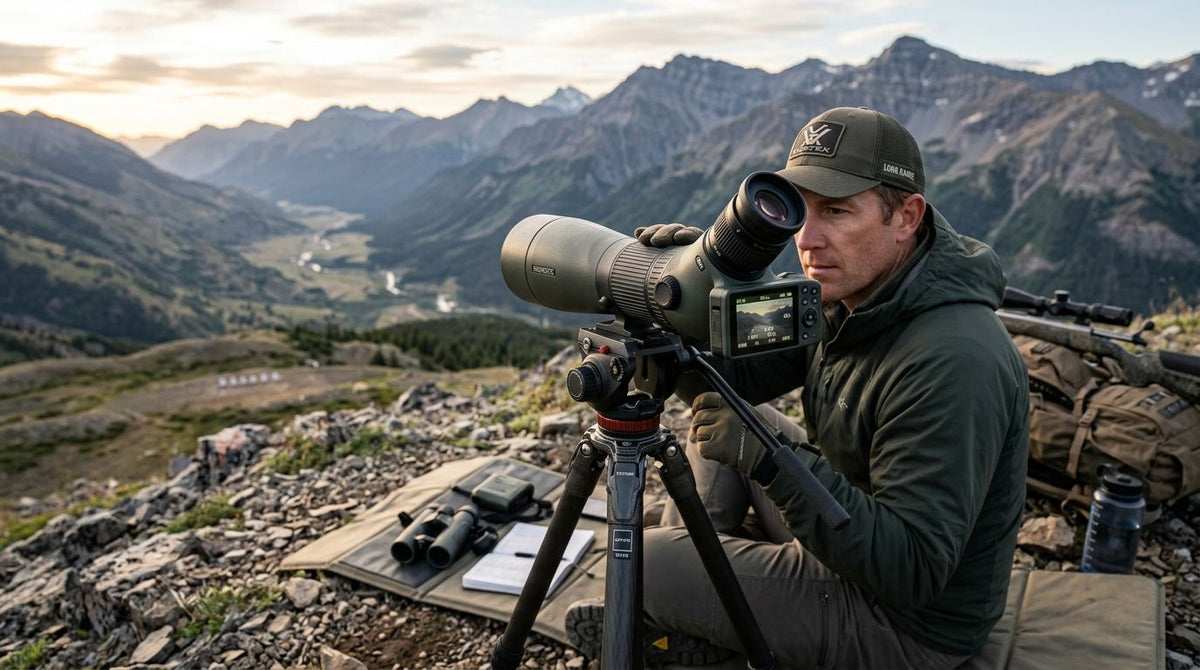
Best overall: Longshot Hawk if you already own a compatible spotting scope and want a live target view on your phone or tablet. Choose the Longshot Ranger+ when you want a standalone target camera for distances up to 1,000 yards, or the Longshot LR-3 when you need a dedicated system with a 2-mile guarantee.
- Longshot Hawk is the best scope camera for shooters who already own a spotting scope.
- Hawk fits eyepieces from 36 mm to 58 mm and streams live HD video.
- Ranger+ is a standalone 1,000-yard target camera; LR-3 carries a 2-mile guarantee.
- All three systems send the target view to a phone or tablet without cell service.
Why this matters
A scope camera and a target camera solve the same business end of the problem in different ways: both put the target image on a screen at the shooting position, but only one uses the spotting scope you already own. Picking the wrong format means carrying more equipment than you need or buying an attachment that does not fit your setup.
Google showed the Longshot Hawk page 1,225 times for “scope camera” from August 11 through September 7, 2026, but only 10 searchers clicked. The product already ranks near the first page for that phrase. The missing piece is a clear explanation of when Hawk is the right choice and when a standalone Longshot camera is better.
Scope camera comparison at a glance
| System | Best for | How it works | Verified range or fit | Main limitation |
|---|---|---|---|---|
| Longshot Hawk | Shooters who already own a spotting scope | Mounts over the spotting-scope eyepiece and streams the optical view | Fits 36–58 mm eyepieces | Requires a compatible spotting scope |
| Longshot Ranger+ | Standalone target viewing at typical long-range distances | Camera is placed near the target and sends a live feed to a phone or tablet | Up to 1,000 yards | Does not use your spotting scope |
| Longshot LR-3 | Dedicated extreme-long-range target viewing | Camera and receiver create a long-distance link between target and firing line | 2-mile guarantee | More components to place and carry |
1. Longshot Hawk: best scope camera for an existing spotting scope
The Longshot Hawk scope camera turns a compatible spotting scope into a live HD viewing system. Slide the Hawk over an eyepiece from 36 mm to 58 mm, connect a phone or tablet through the Longshot app, and use the scope’s optical view without staying behind the eyepiece.
Hawk records at 1920 x 1080 resolution and uses a direct 2.4 GHz connection. It does not need internet, cell service, or range Wi-Fi. The rechargeable battery provides more than 12 hours of runtime, and the complete unit weighs 1 pound.
Longshot Hawk is the best scope camera for shooters who already trust their glass and want to share, record, and mark the target view on a screen.
Hawk advantages
- Uses the spotting scope and tripod you already own.
- Streams live HD video to an iOS or Android phone or tablet.
- Lets you track and number shots, save photos, review sessions, and record video or still images in the Longshot app.
- Runs for more than 12 hours on a charge.
- Includes a charger and carrying case.
- Is drop-resistant and weather-resistant.
Hawk limitations
- The spotting-scope eyepiece must measure between 36 mm and 58 mm.
- Image quality still depends on the spotting scope’s focus, stability, and optical view.
- Hawk is an attachment, not a complete spotting scope or a downrange target camera.
Best for: shooters, spotters, and coaches who already own a compatible spotting scope. Verdict: Buy when you want to digitize the scope you already use.
2. Longshot Ranger+: best standalone target camera up to 1,000 yards
The Longshot Ranger+ target camera removes the spotting scope from the viewing chain. Place the camera near the target and watch the live feed on a phone or tablet from the shooting position.
Ranger+ is rated for target viewing up to 1,000 yards and uses a 5 GHz wireless link. Its 2-megapixel camera feeds the same Longshot app tools used to review impacts and make adjustments without walking downrange.
Ranger+ advantages
- Provides a standalone target view without requiring a spotting scope.
- Covers distances up to 1,000 yards.
- Sends the live view directly to a phone or tablet.
- Works without cell service or an existing internet connection.
- Keeps the camera close to the target, where the image is less dependent on long-distance optical magnification.
Ranger+ limitations
- Requires placing equipment downrange before shooting begins.
- Is a separate camera system rather than an attachment for existing glass.
- Its 1,000-yard range does not match the LR-3’s 2-mile guarantee.
Best for: shooters who want a complete target camera for distances up to 1,000 yards. Verdict: Buy when you want a standalone system instead of a scope attachment.
3. Longshot LR-3: best dedicated target camera for extreme long range
The Longshot LR-3 target camera is the distance-first option. It carries a 2-mile guarantee and uses Longshot’s camera-and-receiver link to send a live target view back to the shooting position.
The camera is set 15 to 20 feet from the target so you can adjust the field of view without relying on optical magnification across the full shooting distance. The system captures 2688 x 1512 imagery, runs for more than 9 hours, and includes a camera, receiver, hard case, two tripods, and two chargers.
LR-3 advantages
- Carries a 2-mile distance guarantee.
- Uses a separate receiver at the shooting position for the long-distance link.
- Places the viewing camera near the target.
- Provides more than 9 hours of runtime.
- Includes the main equipment needed to position both ends of the system.
- Works without cell service or range Wi-Fi.
LR-3 limitations
- Requires more components than Hawk or Ranger+.
- Needs a camera position near the target and a receiver position near the shooter.
- Is unnecessary when a compatible spotting scope and Hawk already solve the viewing problem at your normal distance.
Best for: extreme-long-range shooters who need a dedicated camera-and-receiver system. Verdict: Buy when distance is the deciding factor.
Scope camera versus target camera: which format should you choose?
Choose by the equipment you already own and the distance you actually shoot.
Choose Longshot Hawk when:
- You already own a spotting scope with a 36–58 mm eyepiece.
- You want several people to view the same image on a phone or tablet.
- You want to record the scope view or mark impacts in the Longshot app.
- You prefer one compact attachment over placing a separate camera near the target.
Choose Longshot Ranger+ when:
- You need a complete target camera rather than a spotting-scope attachment.
- Your shooting distance is within 1,000 yards.
- You want the camera close to the target instead of depending on long-range optical clarity.
Choose Longshot LR-3 when:
- You shoot beyond the Ranger+ range.
- You need a 2-mile guarantee.
- You want a camera-and-receiver system built specifically for long-distance target monitoring.
The simplest decision rule is this: Hawk digitizes your existing spotting scope; Ranger+ and LR-3 replace the long-distance optical view with a camera positioned near the target.
How to set up a Hawk scope camera
The Longshot Hawk setup guide covers the full mounting and connection sequence. The essential order is:
- Measure the spotting-scope eyepiece and confirm it falls between 36 mm and 58 mm.
- Focus the spotting scope on the target before mounting the camera.
- Slide the Hawk squarely over the eyepiece and tighten the mount.
- Connect the phone or tablet to the Hawk’s direct wireless network.
- Open the Longshot app and check focus, centering, and brightness.
- Reposition the mount if the image shows a dark ring or clipped edge.
For iPhone and iPad users, Longshot’s official connection tutorial shows the required app permissions, network selection, and “no internet” warning that appears during a direct camera connection.
Watch HOW TO - Connect to iOS - Longshot App on the official Longshot Cameras YouTube channel.
What “no Wi-Fi required” means
The products create their own wireless connection. Your phone or tablet joins that local camera network to receive the video feed, so the setup does not depend on internet access or a range’s wireless service.
A phone may display a warning that the camera network has no internet. Keep the connection. The network’s job is to carry the target video between the Longshot system and the viewing device.
FAQ
What is the best scope camera for long-range shooting in 2026?
Longshot Hawk is the best scope camera for shooters who already own a compatible spotting scope. It fits 36–58 mm eyepieces and streams live HD video to a phone or tablet.
Does the Longshot Hawk include a spotting scope?
No. Longshot Hawk is a camera attachment that mounts over a compatible spotting-scope eyepiece.
What eyepiece size fits the Longshot Hawk?
Longshot Hawk fits spotting-scope eyepieces from 36 mm to 58 mm. Measure the outside diameter before buying or mounting it.
Does a Longshot scope camera need internet?
No. Longshot Hawk creates a direct wireless connection to a phone or tablet, so it does not need internet, cell service, or range Wi-Fi.
How long does the Longshot Hawk battery last?
The Longshot Hawk provides more than 12 hours of runtime on a charge.
Is Ranger+ a scope camera?
No. Ranger+ is a standalone target camera rated for distances up to 1,000 yards; it does not mount to a spotting scope.
How far does the Longshot LR-3 work?
The Longshot LR-3 carries a 2-mile guarantee and uses a camera-and-receiver system for long-distance target viewing.
Can the Longshot app mark bullet impacts?
Yes. The Longshot app can track and number shots, save photos, review sessions, and record video or still images.
One last thing
Do not buy by maximum distance alone. If your spotting scope already gives you the optical view you need, Hawk adds the screen, recording, and shot-marking tools without replacing the scope. If long-distance optical clarity is the problem, move the camera near the target with Ranger+ or LR-3 instead.
Share:
Garmin Xero to Longshot App Workflow (2026 Guide)
How to Use a Scope Camera: Longshot Hawk (2026)