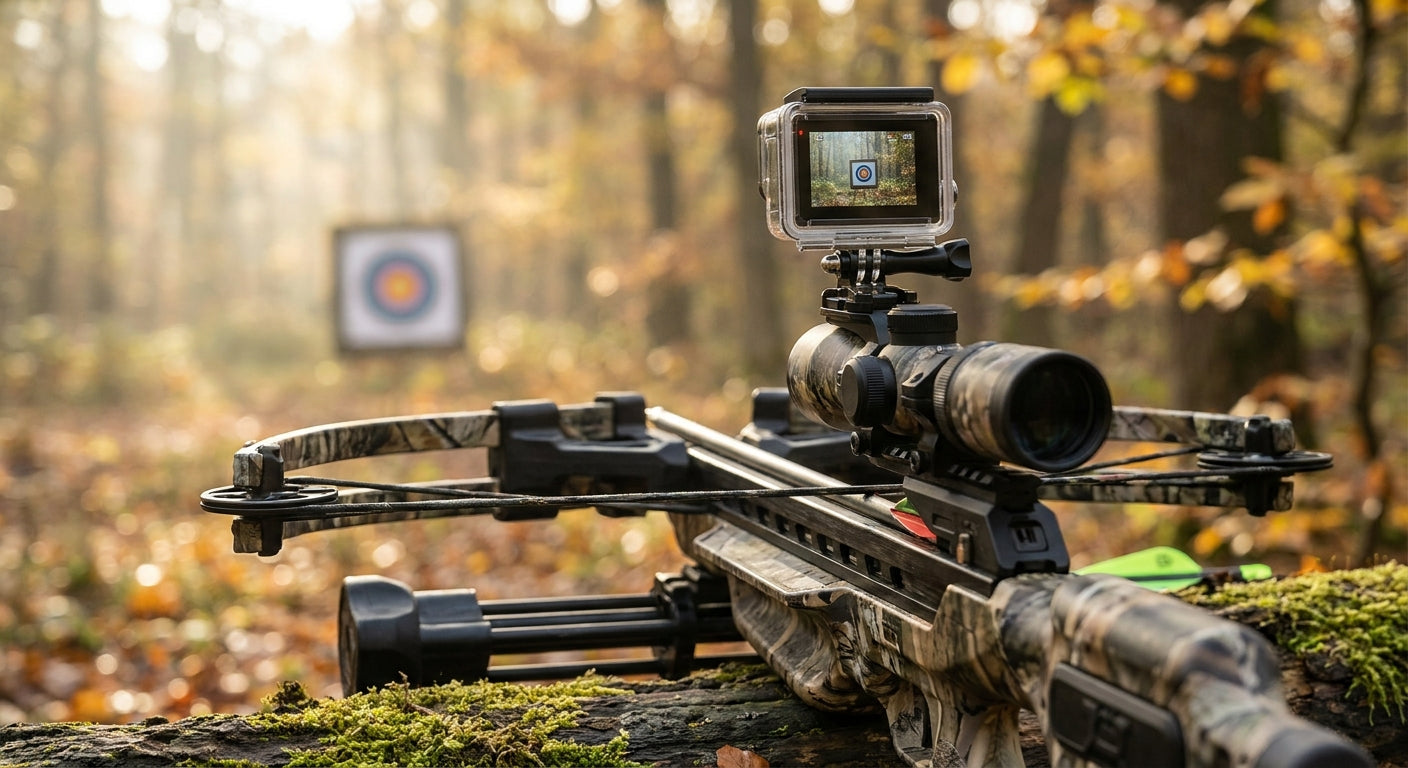
Crossbow hunters don't need a camera built for a 2-mile rifle impact — they need one that confirms a broadhead hit at 20 to 60 yards without a walk that spooks the deer, dumps your scent cone, and burns the last ten minutes of daylight. This guide breaks down which Longshot target cameras actually fit that job in 2026, and which ones are built for a completely different range problem.
- The Longshot Marksman camera is the right crossbow camera for hunting inside 60 yards in 2026 — Buy.
- The Hawk spotting scope camera doubles as scouting glass before the shot — Consider.
- Skip the EC-3's 2-mile range for crossbow work; that resolution is wasted under 60 yards.
- No Wi-Fi or cell signal required matters more for treestand hunters than it does for range shooters.
Why this matters
A crossbow bolt drops fast past 40 yards, and a broadhead cut looks nothing like a field-point hole from 50 yards out through binoculars. Walking to check every shot during practice season means more scent on the ground, more noise, and fewer reps before opening day. A target camera for hunters solves this the same way it solves it for rifle shooters — you see the hit on a tablet instead of hiking to the target and back.
Most trail-camera-style products marketed to hunters in 2026 rely on cell signal or Wi-Fi to push footage, which fails on private land with no coverage. A real target camera pairs directly to a tablet over its own connection, no carrier needed.
Who this is for
This guide is for crossbow hunters practicing bolt placement before season, checking broadhead-versus-field-point offset at hunting distances, and anyone sighting in a new scope on a crossbow without a spotter. It's also relevant to landowners who want a permanent camera on a food-plot range so guests can check their own hits.
What to look for in a crossbow camera for hunting
Range coverage matched to crossbow distances
Crossbow shots are typically taken inside 60 yards, with most ethical shots closer to 20-40 yards. A camera built to guarantee clarity at 2 miles is solving a rifle problem you don't have, and you're paying for glass you'll never use.
No Wi-Fi or cell dependency in the field
Treestands and food plots sit in exactly the kind of low-signal terrain where cell-dependent cameras fail. A system that pairs camera-to-tablet directly keeps working whether you're on public land or three ridges back from the nearest tower.
Battery life for full practice sessions and sits
A short practice session before season might run two hours; a scouting sit can run six. Look for stated runtime in the 8-12 hour range so the camera outlasts you, not the other way around.
Setup speed and portability
You're not bringing a bench and a spotting scope stand to a treestand. A camera that clips to a rail, tripod, or spotting scope in under a minute matters more here than it does on a covered rifle bench.
Image clarity to separate broadhead cuts from field-point holes
A fixed blade broadhead leaves a wider, ragged cut than a field point's clean round hole. Resolution around 2688 x 1512 or better is enough to tell the two apart at 40-60 yards on a tablet screen.
Weatherproofing across a full scouting season
Crossbow practice runs from summer heat into late-season cold. A housing rated for outdoor use matters more here than on an indoor range, since the camera is exposed to rain and temperature swings for months at a stretch.


Top picks for crossbow hunters
Longshot Marksman camera — the sweet spot. This is the camera built for exactly the distance range crossbow hunters actually shoot: close enough to matter, far enough to skip the hike. It pairs to the Longshot tablet without needing cell or Wi-Fi in the field, which is the whole point when you're set up on private land with no bars. Verdict: Buy — matches crossbow range without the premium of a rifle-grade system.
Hawk spotting scope camera — the wildcard. Instead of a dedicated unit, this clips onto a spotting scope you may already own between 36mm and 58mm eyepiece, turning glass you use for scouting into a live-view camera. Runtime is rated at 12+ hours, enough for a full-day sit plus the drive home. Verdict: Consider — best for hunters who already carry a scope and want dual use out of it.
EC-3 two-mile camera — the overkill pick. This is built to guarantee clarity at 2 miles with 2688 x 1512 HD imagery, which is a rifle long-range problem, not a crossbow one. At $499 it's priced for that longer job, and a crossbow hunter checking a 40-yard bolt hit is paying for resolution they'll never need. Verdict: Skip for pure crossbow use — Consider only if you're also running a rifle setup on the same land.
Ranger permanent-install camera — the food-plot option. For landowners who want a fixed camera on a private range so multiple hunters can check hits without hauling gear, a permanent install skips the setup step entirely. It's a different use case than a portable unit you move stand to stand. Verdict: Consider if the range stays put; Skip if you're hunting different stands each week.
What to avoid
- Cell-signal trail cameras rebranded as target cameras. They look right in a product photo but fail the second you're out of coverage, which is most of the land crossbow hunters actually hunt.
- Long-range rifle systems bought out of habit. A 2-mile guarantee is a rifle spec. Paying for it to check a 40-yard bolt hit is money spent on a problem you don't have.
- Cameras with no cold-weather rating. Late-season crossbow hunts run into freezing temperatures, and a battery or housing not rated for it will quit on you mid-sit.
Verdict comparison
| Camera | Best crossbow range | Wi-Fi/cell needed | Verdict |
|---|---|---|---|
| Longshot Marksman | 20-60 yards | No | Buy |
| Hawk spotting scope camera | 20-100 yards (scope-dependent) | No | Consider |
| EC-3 two-mile camera | Up to 2 miles | No | Skip for crossbow |
| Ranger permanent install | Fixed range setup | No | Consider for food plots |
FAQ
What's the best crossbow camera for hunting in 2026?
The Longshot Marksman camera is the best fit for crossbow hunting in 2026 because it's built for the 20-60 yard range most crossbow shots fall into, without paying for long-range rifle resolution you won't use.
Do target cameras need Wi-Fi or cell service to work in the field?
No. Longshot cameras pair directly to a tablet without needing Wi-Fi or cell signal, which matters most for treestand and food-plot setups on land with no coverage.
Is the EC-3 camera overkill for crossbow hunting?
Yes, for pure crossbow use. The EC-3 guarantees clarity at 2 miles, a rifle-range spec, while crossbow shots are typically taken inside 60 yards.
Can a target camera tell a broadhead hit from a field-point hole?
At 2688 x 1512 resolution or better, yes, a broadhead's wider ragged cut is distinguishable from a field point's clean round hole at 40-60 yards on a tablet screen.
How long does a target camera battery last during a hunting sit?
The Hawk spotting scope camera is rated for 12+ hours of runtime, enough to cover a full-day sit plus setup and teardown.
Is a permanent camera install worth it for a private hunting range?
Yes if the range stays in one location, such as a food plot. A permanent-install camera like the Ranger skips setup entirely for repeat use by multiple hunters.
Can I use a spotting scope I already own as a target camera?
Yes, the Hawk spotting scope camera clips onto eyepieces between 36mm and 58mm, turning an existing scope into a live-view camera without buying a dedicated unit.
How much does a crossbow-appropriate target camera cost in 2026?
Prices range from around $299 for a spotting scope clip-on camera to over $700 for a dedicated camera-and-tablet bundle, depending on range guarantee and included accessories.
One last thing
Most crossbow hunters overbuy range guarantee and underbuy battery life — a $499 camera rated for 2 miles is useless if it dies at hour three of a six-hour sit. Check runtime before range spec; the extra miles almost never get used, and the dead battery always does.
Share:
Best Rifle Cover for Hunting in 2026: Ranked Picks
Best Rifle Cover for Hunting in 2026: Ranked Picks