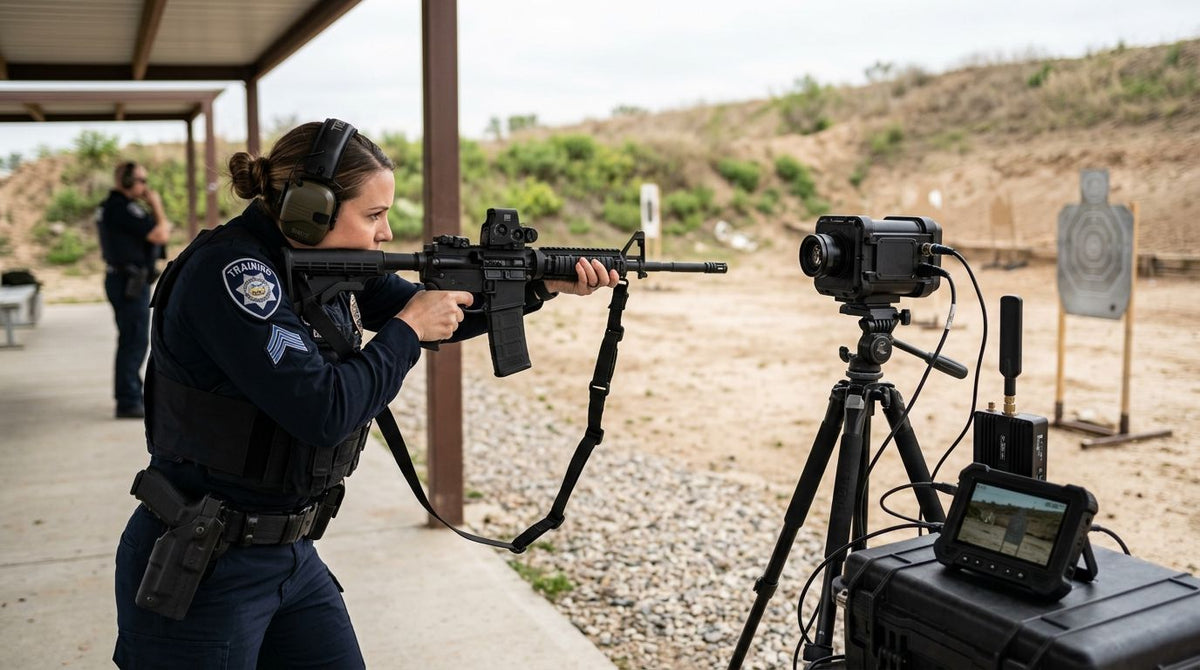
Target camera for law enforcement firearms training is a downrange video system that puts bullet-impact footage on a screen at the firing line, so instructors and range safety officers score qualification runs without walking targets or losing training time. Agencies running 25-yard pistol qualification lanes and 100-yard patrol rifle courses need different coverage than a hunting or competition setup, and the gear has to survive back-to-back squads all day without a signal drop.
- Longshot LR-3 is the strongest target camera for law enforcement firearms training on multi-lane ranges out to 2 miles.
- Marksman covers single-lane qualification setups where an agency doesn't need full multi-lane coverage yet.
- Hawk mounts on existing spotting scopes RSOs already carry, so there's no separate camera housing to buy.
- None of these require Wi-Fi or cell service, which matters on indoor ranges and rural agency properties.
- Pair the camera with a Longshot Tablet at purchase instead of sourcing hardware separately later.
Why target cameras matter for law enforcement firearms training
Agency ranges run differently than a private club or a hunting camp. Instructors qualify multiple officers back to back, RSOs need eyes on impacts in real time to catch unsafe patterns, and downtime spent walking to targets between strings eats directly into a training day that's already scheduled tight. A target camera for range safety officers lets one instructor watch a lane's impacts on a tablet while the officer is still on the line, instead of calling a cease-fire to walk downrange and check a target sheet.
Most agency ranges, especially indoor facilities and rural training sites, don't have reliable Wi-Fi or cell coverage at the firing line. A target camera that depends on internet access for basic function is a liability on the exact ranges where firearms qualification actually happens. That's the baseline requirement before anything else on this list matters.
Setting up a target camera system for law enforcement firearms training
1. Map your lanes, distances, and qualification courses
Before buying anything, write down what your range actually runs. A camera sized for a 25-yard pistol qual won't cover a 100-yard patrol rifle course, and a system built for one lane won't scale cleanly to a five-lane bay.
- List every qualification distance your agency currently runs, from close-quarters pistol to long-gun
- Count active lanes that need simultaneous coverage during a class
- Note indoor vs. outdoor bays, since mounting and weatherproofing differ
- Flag any lanes with mirage or heat distortion issues at distance
- Identify whether the range has permanent camera mounts or needs portable setups per session
2. Pick a camera system rated for your farthest qualification distance
The manual option is a spotting scope and a human walking targets between strings, which works but burns instructor time on every qualification day. The faster path is a camera rated past your farthest course of fire. The LR-3 camera system is built for exactly this: multi-lane duty use with confirmed coverage out to 2 miles, well past any standard qualification distance.
- Confirm the camera's rated distance covers your longest course of fire with margin, not exactly at the limit
- Check if the system needs Wi-Fi or cell service to function at all
- Verify the imagery resolution is sharp enough to call shot placement, not just presence of a hit
- Ask whether the unit supports permanent indoor/outdoor install if you're building out a fixed range
- Confirm battery runtime covers a full qualification day without a mid-session swap
3. Eliminate Wi-Fi and cell dependency before you install
Don't assume the range has connectivity, even indoors. Plenty of agency facilities sit in basements, converted warehouses, or rural land with no signal at all.
- Test the system's actual connection method before qualification day, not during it
- Confirm the tablet pairs directly to the camera without routing through a network
- Check whether multiple lanes can run independently without interfering with each other's signal
- Verify range in feet/yards the camera-to-tablet connection holds under real range conditions
4. Train instructors and range safety officers on live monitoring
A camera system is only as useful as the person reading it. Instructors need to trust the feed enough to stop walking targets, and RSOs need to know how to spot unsafe shot patterns in real time.
- Walk every instructor through the live feed before their first qualification session
- Set a standard for when a cease-fire is still called despite camera coverage
- Confirm RSOs know how to zoom or switch lanes on the tablet mid-course
- Document who's responsible for the tablet during a multi-lane session
5. Standardize qualification scoring with recorded footage
Once impacts are visible live, agencies can also review footage after the fact instead of relying on a target sheet an officer walked back with. This matters for disputed scores and for training file documentation.
- Decide whether footage gets saved per officer or per session
- Set a retention policy that matches your agency's training records requirements
- Use recorded impacts to review shot groups with an officer after their string, not just the final score
- Confirm the tablet or app stores footage locally if the range has no network for cloud upload
6. Protect and maintain gear under high round counts
Agency ranges see more rounds per session than a weekend hobbyist setup, and that means more debris, more heat, and more wear on optics and housings.
- Wipe down camera lenses between sessions, especially on dusty outdoor ranges
- Check housing seals if the unit sits near a berm catching fragment spray
- Store cameras in a hard case between training days instead of leaving them mounted outdoors
- Rotate batteries on a schedule rather than running them to zero every session
7. Scale from one lane to a full multi-lane range
Most agencies start with one or two lanes and expand as budget allows. Plan the buildout so adding lanes later doesn't mean replacing what's already installed.
- Standardize on one camera system across all lanes so training and maintenance stay consistent
- Confirm additional cameras pair to the same tablet setup already in use
- Budget for permanent indoor or outdoor install if the range is fixed and not rotating locations
- Keep one spare unit on hand for a multi-lane range so one failure doesn't cancel a session
Comparison: target camera options for law enforcement firearms training
| Option | Best for | Key limitation |
|---|---|---|
| Longshot LR-3 | Multi-lane duty ranges running qualification out to 2 miles | Full multi-lane coverage needs one camera per lane |
| Marksman | Single-lane or basic qualification setups on a tighter budget | Shorter maximum range than LR-3 |
| Hawk spotting scope camera | Agencies mounting onto spotting scopes instructors already own | Requires an eyepiece between 36mm and 58mm to fit |
| RangerPlus | Agencies wanting a portable, scope-mounted option for rotating locations | Not built for permanent fixed-lane install |
Verdict: for a multi-lane duty range running qualification through 100 yards and beyond, the Longshot LR-3 is the target camera for law enforcement firearms training that scales without a hardware swap later.


Common mistakes agencies make with target cameras for law enforcement firearms training
- Buying one camera for a five-lane bay. Coverage gets split thin and instructors end up walking targets on the lanes without a unit anyway.
- Skipping RSO training on the tablet feed. If the range safety officer doesn't trust the live feed, they walk downrange out of habit and the time savings disappear.
- Assuming Wi-Fi will be there. Plenty of agency ranges have no signal at the firing line, and a camera that needs one is dead weight on qualification day.
- Leaving cameras exposed to fragment spray at close qualification distances. Housings take more abuse at 25 yards than at 500, and that wear adds up over a training year.
- Buying camera and tablet separately instead of paired. Pairing hardware at purchase avoids a setup delay before the first training session.
FAQ
What is the best target camera for law enforcement firearms training in 2026?
The Longshot LR-3 is the strongest option for multi-lane agency ranges in 2026, with coverage out to 2 miles and no Wi-Fi or cell service required. Agencies running a single lane or a tighter budget can start with the Marksman instead.
Do target cameras work without Wi-Fi at an indoor range?
Yes, Longshot camera systems pair directly to a tablet without needing internet or cell service. This matters on indoor agency ranges and rural training sites where connectivity is unreliable or absent.
Can a target camera mount on a spotting scope instructors already own?
The Hawk spotting scope camera fits eyepieces between 36mm and 58mm and turns an existing scope into a live video feed. It's a lower-cost path for agencies that don't want to buy a standalone camera housing.
How many cameras does a multi-lane qualification range need?
Full coverage on a multi-lane range needs one camera per active lane so instructors can monitor every officer simultaneously during qualification. Sharing one unit across lanes forces instructors back to walking targets on the uncovered lanes.
Is Marksman or LR-3 better for a single-lane agency range?
Marksman is built for single-lane or basic qualification setups and costs less than LR-3. LR-3 is the better buy if the agency plans to add lanes or extend qualification distance later.
Can target camera footage be used for training file documentation?
Recorded impact footage can be saved and reviewed after a qualification session, which supports documentation beyond a walked target sheet. Retention should match the agency's existing training records policy.
What distance does a Longshot target camera cover?
Longshot's LR-3 and EC-3 systems carry a straight shooter guarantee to 2 miles, far beyond any standard law enforcement qualification distance. Standard duty ranges rarely exceed 100 yards, so the extra range headroom accounts for future course changes.
Do target cameras replace the range safety officer?
No. A target camera gives the RSO a live view of impacts, but agencies should still set a clear standard for when a cease-fire is called regardless of camera coverage.
One last thing
The EC-3 extra camera unit ships with CrispEdge 2688 x 1512 HD imagery, sharp enough to call individual shot placement inside a qualification target rather than just confirming a hit landed somewhere on paper. That resolution difference is what separates a camera that saves walking time from one that actually replaces a walked-target inspection for scoring purposes.
Share:
Best Chronograph for Reloading in 2026: Ranked
Long Range Shooting Gear Search Demand by Category 2026