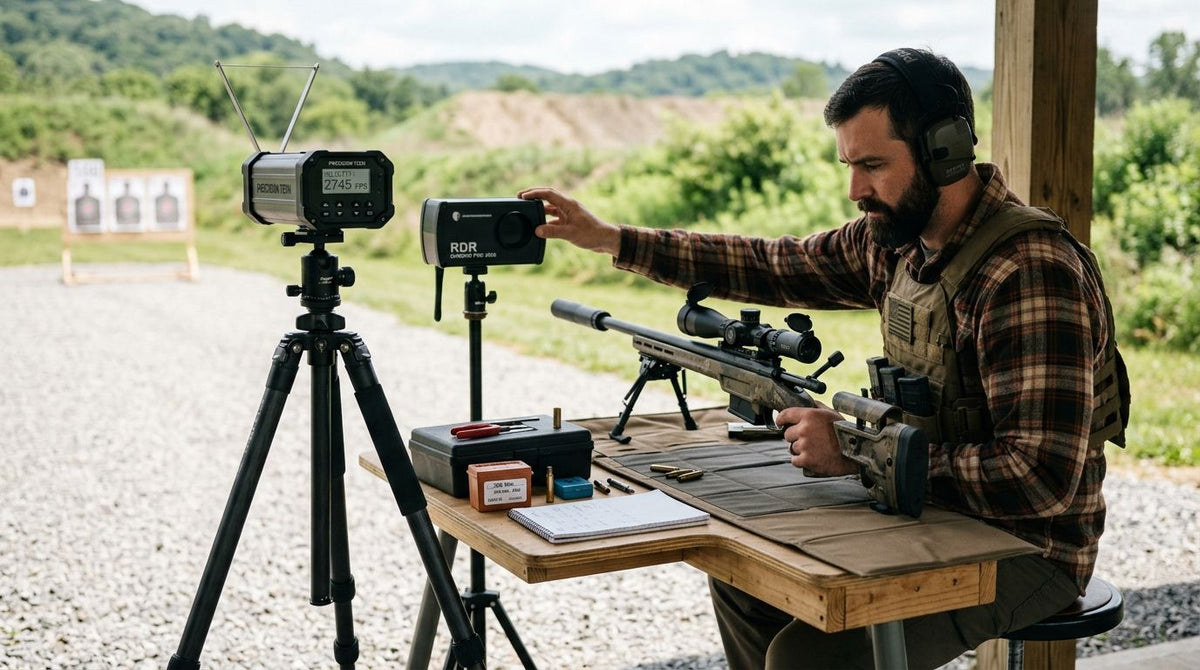
The best chronograph for reloading in 2026 depends on how you test loads. Garmin Xero C1 Pro Chronograph is the strongest all-around pick for precision reloaders, Labradar LX wins for bench rest load development, and SpeedTracker Mach IV Chronograph covers reloaders who want a simpler velocity check without a radar unit.
- Garmin Xero C1 Pro Chronograph is the best chronograph for reloading overall in 2026 — buy it.
- Labradar LX wins bench rest load development; SpeedTracker Mach IV Chronograph wins on budget.
- Doppler radar chronographs read velocity beside the shooter, skipping light-gate alignment hassles entirely.
- Pair chronograph velocity data with target camera impact data to close the reloading feedback loop.
Why this matters
Muzzle velocity is the number every load development session comes back to. A chronograph tells you how consistent a powder charge really is across a five-shot string — data a group on paper can't give you by itself.
Reloaders who skip a chronograph are guessing at velocity spreads that show up later as vertical stringing at distance. Pairing that velocity data with impact location closes the loop: you already know how to zero your rifle faster with a target camera, and a chronograph reading tells you why a load groups the way it does before you ever walk downrange.
This guide ranks the chronograph options precision reloaders actually reach for in 2026 — at the bench, in the field, or on a budget — not by spec sheet alone.
What makes the best chronograph for reloading
- Sensor technology — Doppler radar units read velocity beside the shooter; photoelectric-style units sit in front of the muzzle and depend on light gates.
- Setup speed at the bench — a chronograph that needs precise light-gate alignment costs you range time before the first shot counts.
- String-to-string consistency — the point of chronographing a load is catching extreme spread across a five-shot or ten-shot string, not one lucky reading.
- Portability between range and field — a unit built for a covered bench doesn't always survive being packed for a field session.
- Data logging — a chronograph that logs strings automatically beats writing numbers on a data card between shots.
- Fit with existing kit — mounts and bench accessories only matter if they fit the chronograph you already own.
Best chronographs for reloading in 2026 — at a glance
| Chronograph | Best for | Standout feature | Key limitation |
|---|---|---|---|
| Garmin Xero C1 Pro Chronograph | Overall precision reloading | Doppler radar reads velocity beside the shooter, not downrange | Domestic (US) sales only, per current listing |
| Labradar LX | Bench rest load development | Radar tracking holds a reading through a full load ladder | Needs a stable surface and correct trigger placement |
| SpeedTracker Mach IV Chronograph | Budget range-day velocity checks | Straightforward setup without a radar-based learning curve | Less documented feature set than the radar options above |
| Labradar Bench Mount | Repeatable bench positioning | Locks radar angle and height across an entire ladder | Not a chronograph itself; fits Labradar units only |
1. Garmin Xero C1 Pro Chronograph: best chronograph for reloading overall
Garmin Xero C1 Pro Chronograph uses Doppler radar to track the bullet from a position beside the shooter instead of downrange or directly under the muzzle. That layout is why it ranks first: no light-gate alignment, no muzzle blast interference, and no walking out to reposition hardware between calibers.
It works across a wide range of cartridges and reads velocity the moment the shot leaves the barrel, then logs it for review after the string.
Garmin Xero C1 Pro Chronograph pros:
- Radar positioning skips the light-gate alignment issues that slow down bench sessions
- Works across a wide range of calibers without repositioning hardware
- Compact tripod-mount footprint fits most reloading bench setups
Garmin Xero C1 Pro Chronograph cons:
- Sold for domestic (US) sales only, per current store listing
- Radar-based units cost more up front than basic photoelectric chronographs
- Battery life matters more on long load-development sessions; plan around charge cycles
Best for: precision reloaders who want the least amount of chronograph fuss and the most reliable string data.
Verdict: Buy.
2. Labradar LX: best chronograph for bench rest load development
Labradar LX is a Doppler radar chronograph built around the same core idea as the Xero — it tracks the shot from behind the muzzle rather than in front of it — but it's suited to repeatable bench rest sessions where you're firing across multiple powder charges in one sitting.
Because it doesn't need direct alignment under the bullet's flight path, it holds a reading through a full load-development ladder without being nudged between strings.
Labradar LX pros:
- Radar tracking avoids the light-gate fuss that slows down optical chronographs
- Handles long load-development sessions without repositioning between charges
- Works across subsonic and standard-velocity loads without recalibration
Labradar LX cons:
- Needs a stable, level surface and correct trigger placement to get a clean read
- Radar units are pickier about consistent unit placement than a simple mount
Best for: reloaders running full load-development ladders at a covered bench.
Verdict: Buy.
3. SpeedTracker Mach IV Chronograph: best budget chronograph for range day checks
SpeedTracker Mach IV Chronograph is the entry point for reloaders who want a velocity reading without stepping up to a radar-based unit. It's built for a straightforward job: mount it, fire the string, read the numbers.
It won't replace a Doppler radar chronograph for bench rest ladder testing, but for a reloader who just wants to confirm a load is running where it should before a match, it does the job without the setup overhead of a full radar rig.
SpeedTracker Mach IV Chronograph pros:
- Straightforward setup for reloaders who don't need radar-level features
- A lower-complexity option than Labradar LX or Garmin Xero C1 Pro Chronograph
- Fits into a range bag without the bulk of a tripod-mounted radar unit
SpeedTracker Mach IV Chronograph cons:
- Less documented feature set than the radar-based options above — confirm compatibility with your setup before buying
- Not built for the long, multi-charge ladder sessions a bench rest chronograph handles
Best for: reloaders who want a quick velocity check without a radar-based learning curve.
Verdict: Buy if budget is the deciding factor; hold out for a radar unit if you're running full load ladders.
4. Labradar Bench Mount: best accessory for repeatable bench positioning
Labradar Bench Mount isn't a chronograph — it's the accessory that makes a Labradar LX behave consistently across a bench rest session. It locks the radar unit's height and angle so every string in a load-development ladder gets measured from the same position.
That consistency matters more than it sounds. A Doppler radar chronograph that shifts angle between charges introduces its own variable into a session that's supposed to be testing powder, not hardware.
Labradar Bench Mount pros:
- Keeps radar angle and height constant across an entire load-development session
- Frees up a hand during string-to-string charge changes
- Purpose-built for Labradar units, so it fits without workarounds
Labradar Bench Mount cons:
- Doesn't work with other chronograph brands
- Adds a piece of gear to pack for range day, on top of the chronograph itself
Best for: reloaders who run the same Labradar LX through repeat bench sessions and want the mount solved once.
Verdict: Buy alongside a Labradar LX; skip if you're not running that unit.
How we ranked
The ranking above weighs sensor technology first — Doppler radar earns the top two spots because it removes the light-gate alignment work that eats into range time. The budget and accessory picks fill out the list based on where they fit a reloader's actual bench routine, not brand recognition. Every pick gets an honest limitation listed next to it, because a chronograph that measures the wrong thing for your workflow is a chronograph you won't use in 2026.
Which chronograph should you choose?
If you want one answer and you're done reading: Garmin Xero C1 Pro Chronograph is the best chronograph for reloading in 2026 for most precision shooters, because it removes the setup friction that makes reloaders skip chronographing altogether.
Running a full load-development ladder at a covered bench? Labradar LX paired with the Labradar Bench Mount holds a consistent read across dozens of rounds without you touching the unit between charges.
Just want a number before a match without buying into a radar-based system? SpeedTracker Mach IV Chronograph gets you there for less complexity.
FAQ
What's the best chronograph for reloading in 2026?
Garmin Xero C1 Pro Chronograph is the best chronograph for reloading in 2026 for most precision shooters because its Doppler radar setup skips light-gate alignment. Labradar LX is the stronger pick for full bench rest load-development ladders.
Is a Doppler radar chronograph better than a photoelectric one for load development?
For load development, yes — radar units read velocity beside the shooter instead of in front of the muzzle, so they don't need precise light-gate alignment between strings. Photoelectric units still work, they just take more setup time per session.
How many shots should you chronograph per powder charge?
A five-shot string per charge is standard practice for catching extreme spread during load development. Some reloaders run ten-shot strings on a final load before committing to it.
Does the Labradar LX need direct sunlight to get a reading?
No. Labradar LX uses Doppler radar rather than a light-based sensor, so lighting conditions don't affect the reading the way they can with photoelectric chronographs.
Can a chronograph replace walking downrange to check impacts?
No. A chronograph measures velocity only — it doesn't tell you where the bullet landed. Pairing chronograph data with a target camera's impact data covers both halves of load development.
What is the Labradar Bench Mount for?
Labradar Bench Mount stabilizes a Labradar LX at a fixed height and angle so every string in a bench rest session gets measured from the same position. It only fits Labradar units.
Is the Garmin Xero C1 Pro Chronograph sold outside the US?
Per its current store listing, Garmin Xero C1 Pro Chronograph is sold for domestic (US) sales only.
One last thing
A chronograph only tells you half the story. It confirms a load is consistent in velocity, but it can't tell you why a consistent load is still stringing vertically at distance. That's the gap a target camera closes — pairing Longshot Target Cameras' impact data with a chronograph's velocity data turns two separate range trips into one feedback loop. Reloaders running that combination catch seating depth and charge issues faster than chronograph data alone ever shows them, because they're looking at cause and effect on the same range day instead of guessing between sessions with a Longshot camera and a chronograph running separately.
Share:
Best Powder Trickler for Reloading in 2026: Ranked
Target Camera for Law Enforcement Firearms Training 2026