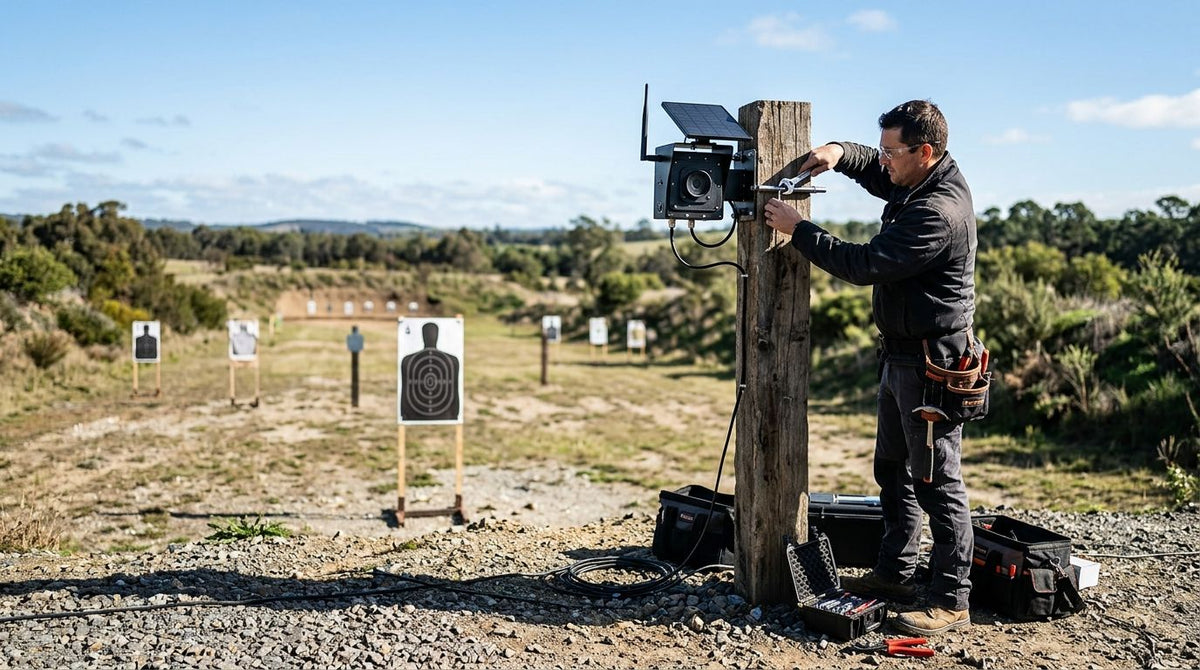
Installing a permanent target camera system at a range costs $738 to $2,535 in 2026 for the camera hardware and tablet, depending on how many lanes you're covering. That figure is the equipment cost only — permanent mounting brackets, conduit runs to each bay, and any power hookup are added by the range and not included in any kit price.
- Permanent target camera installs at Longshot Cameras run $738 to $2,535 in 2026 for hardware and tablet.
- A single-lane Marksman 1 setup starts at $738; a 4-camera LR-3 kit tops out at $2,535.
- Mounting, conduit, and power runs are added by the range and not included in kit pricing.
- Adding lanes later costs $499 per EC-3 camera instead of buying a new kit.
- No Wi-Fi or cell service is required, so connectivity infrastructure doesn't add to the cost.
Why this matters
A permanent install is a different decision than buying one camera for a weekend at the range. Rangemasters and club boards need a per-lane number they can put in a budget line, plus a sense of what's included versus what the facility has to supply on its own.
Longshot's cameras are built to run without Wi-Fi or cell service and to hold a line of sight up to 2 miles, which matters for outdoor bays where trenching a data line to every lane isn't realistic. That's the core reason ranges choose a permanent target camera system over walkie-talkies and binoculars: shooters see impacts from the shooting position instead of walking downrange between strings.
How much does it cost to install a permanent target camera system at a range?
The hardware cost scales with lane count, not with whether the install is temporary or permanent. Here's what each configuration runs in 2026:
| System | Cameras | Price (hardware + tablet) | Best for |
|---|---|---|---|
| Marksman 1 | 1 | $738 | Single indoor bay |
| LR-3 | 1 | $1,188 | Single long-range outdoor lane |
| LR-3 2 Camera Kit | 2 | $1,637 | Two-lane range |
| LR-3 3 Camera Kit | 3 | $2,086 | Three-lane range |
| LR-3 4 Camera Kit | 4 | $2,535 | Four-lane range |
Verdict: a single-bay indoor range should budget $738-$1,188 per lane; a four-lane outdoor range should budget $2,535 for the camera side of the project, plus mounting and cabling.
Single-lane permanent installs: $738-$1,188
A single bay only needs one camera and one tablet. The Marksman 1 at $738 covers short indoor distances where the shooter and the target are close together and mounting is simple — bolt the housing to a bench rail or wall bracket and point it downrange.
The LR-3 at $1,188 is the right call when the lane runs long, since it's built for the same 2-mile line-of-sight capability Longshot uses across its outdoor lineup. Ranges with a 100-yard or longer single bay generally pick the LR-3 over the Marksman even though it costs $450 more, because the extra reach avoids a second camera purchase later.
Verdict: Buy Marksman 1 for short indoor bays, buy LR-3 for anything past 100 yards on a single lane.
Multi-lane range installs: $1,637-$2,535
Ranges covering more than one shooting position at once move to a kit. The LR-3 4-camera kit bundles four cameras with a single tablet and Bulletproof Warranty coverage for $2,535, which works out to roughly $634 per lane — cheaper per camera than buying four Marksman 1 units separately.
The 2-camera ($1,637) and 3-camera ($2,086) kits scale the same way for smaller ranges that don't need a full four-bay buildout in year one. All three multi-camera kits ship with one control tablet, so the facility decides whether shooters view their own lane on a shared screen at the bench or the range runs one central monitoring station.
Verdict: Buy a multi-camera LR-3 kit over separate single-camera units whenever you're outfitting three or more lanes at once — the per-lane cost drops with every camera added to the same order.
Adding cameras to an existing permanent install
Ranges rarely build out every lane on day one. An EC-3 extra camera runs $499 and pairs with an existing LR-3 system, so a club can install two lanes this year and add a third or fourth camera next season instead of re-buying a whole kit. That's usually the cheaper path once the base LR-3 or Marksman system and tablet are already on-site.
Why installation cost varies
- Number of shooting lanes — each lane needs its own camera; a four-lane range costs roughly 3.4x a single-lane Marksman 1 setup.
- Distance from firing line to target — Marksman covers short indoor bays, while LR-3 and additional EC-3 cameras are built for the full 2-mile range Longshot's systems support.
- Indoor vs. outdoor exposure — outdoor bays need weatherproof permanent mounting hardware the range typically sources locally; indoor bench mounts are simpler.
- Shared vs. per-lane tablet — kits ship with one tablet, so ranges that want a screen at every bench add tablets separately instead of relying on the bundled unit.
- Buying a kit upfront vs. expanding later — a 4-camera kit at $2,535 costs less per lane than starting with one Marksman 1 and adding EC-3 cameras one at a time.
- Warranty coverage on high-round-count ranges — public and club ranges with heavy daily use often add Bulletproof Warranty coverage, which the multi-camera kits already include.
Does a permanent installation cost more than a portable setup?
No — permanent and portable Longshot installs use the same $738 to $2,535 hardware pricing; there's no separate "permanent" product line. The added cost of a permanent build is mounting brackets, conduit, or power runs the range supplies, not a markup on the camera itself.
Can a range add cameras after the initial install?
Yes — an EC-3 extra camera costs $499 and connects to an existing LR-3 system without requiring a new kit purchase. This is how most multi-lane ranges expand coverage one bay at a time instead of budgeting for a full rebuild.
Do permanent range cameras need Wi-Fi or a cell connection?
No — Longshot's systems are built to operate with no Wi-Fi or cell service required, which is why outdoor ranges without internet infrastructure can still run a permanent multi-lane setup without adding a data line to every bay.


FAQ
How much does it cost to install a permanent target camera system at a range?
A permanent target camera system costs $738 to $2,535 in 2026 for the camera hardware and tablet, scaling with lane count. Mounting, conduit, and power hookups are separate and vary by range.
What's the cheapest permanent camera setup for one lane?
The Marksman 1 at $738 with tablet is the cheapest single-lane option, best suited to indoor bays where the target sits at a short, fixed distance.
How much does a 4-lane range camera install cost?
A four-lane install costs $2,535 using the LR-3 4 Camera Kit, which bundles four cameras with one tablet and Bulletproof Warranty coverage.
Can I add a camera to an existing range system instead of buying a new kit?
Yes, an EC-3 extra camera costs $499 and pairs with an existing LR-3 setup, letting ranges expand one lane at a time.
Do permanent target cameras need Wi-Fi or cell service?
No, Longshot's camera systems run without Wi-Fi or cell service, which matters for outdoor ranges with no on-site internet.
Is the LR-3 or Marksman 1 better for a permanent outdoor install?
The LR-3 at $1,188 is better for outdoor lanes over 100 yards since it's built for Longshot's full 2-mile line-of-sight range; the Marksman 1 at $738 fits short indoor bays.
Does a multi-camera kit include a tablet for every lane?
No, LR-3 kits ship with one tablet regardless of camera count, so ranges wanting a screen at every bench add tablets separately.
Is it cheaper to buy a 4-camera kit or four single cameras?
The 4-camera kit at $2,535 works out to about $634 per camera, which is cheaper than buying four single-camera systems separately.
One last thing
The EC-3 extra camera at $499 is usually the smarter buy for ranges that aren't ready to commit to a full four-lane budget in year one. Installing an LR-3 or Marksman 1 base system now and adding EC-3 cameras as lanes come online spreads the $2,535 four-camera cost across multiple budget cycles instead of one line item.
Share:
How Long Does a Target Camera Battery Last (2026)
How to Use a Shooting Range App in 2026