
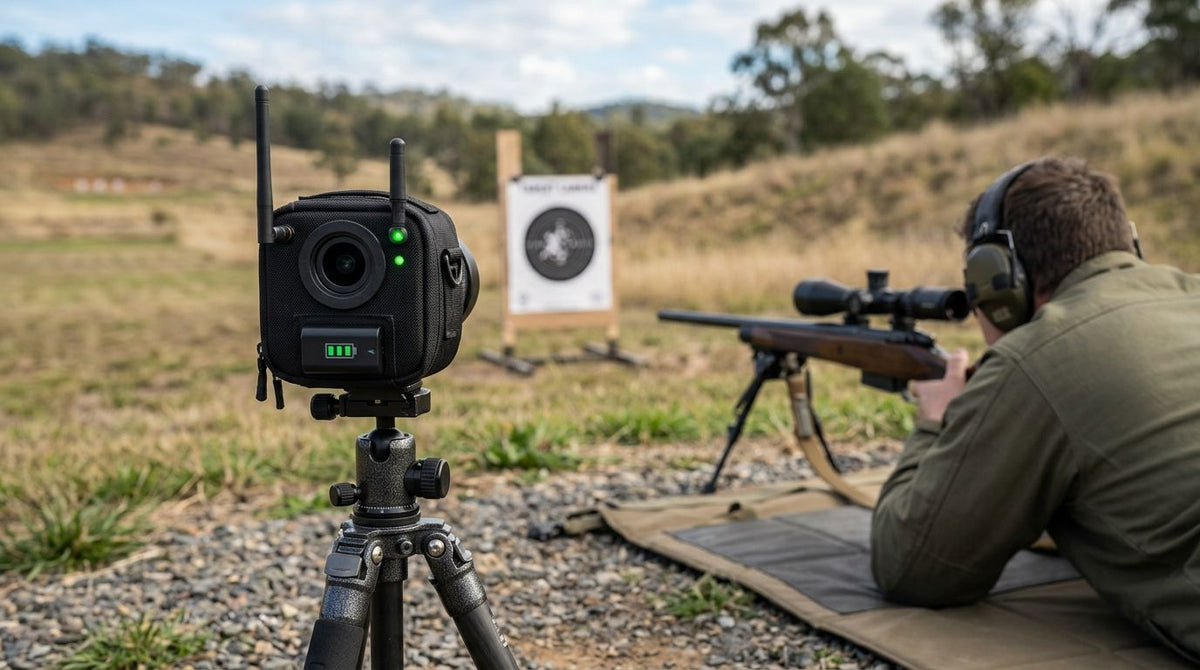
The Longshot Hawk spotting scope camera runs 12+ hours per charge in 2026, and that's the only battery-life figure Longshot publishes across its target camera lineup. The LR-3, Marksman, and EC-3 systems don't carry a stated runtime because how long they last per charge depends on how much live video you stream, how bright the paired tablet screen sits, and how cold the range gets that day.
- The Hawk spotting scope camera runs 12+ hours per charge — the only Longshot model with a published runtime.
- LR-3, Marksman, and EC-3 target cameras have no published runtime; streaming habits and temperature decide the real number.
- A swappable Li-ion Replacement Battery lets Marksman and LR-3 owners carry a charged spare through a full match day.
- How long a target camera battery lasts in 2026 depends more on how you use it than on the model.
Why this matters
A dead battery mid-match forces exactly the problem a target camera is supposed to solve: walking downrange to check impacts by hand instead of watching them land from the bench. Longshot builds its cameras to run without Wi-Fi or cell service — read how that connection actually works in Longshot's no-Wi-Fi range setup — which means the battery alone has to carry the camera, the wireless link to your Longshot Tablet, and the live video feed for the entire session.
That matters more the farther out you're shooting. A shooter running an ELR setup at 1,000 yards or checking impacts up to 2 miles downrange doesn't get a second chance to glass a miss if the camera dies mid-string. Ranges running a permanent indoor or outdoor install face the same math on a bigger scale: a camera that can't hold a charge through a full day of lane use turns into a maintenance ticket.
This runtime question sits inside a bigger point Longshot is building toward: cameras, tablets, and a shooting and reloading data ecosystem only work together if none of the pieces quit mid-session. A battery that dies partway through a string breaks that whole chain, not just the video feed.
How long does a target camera battery last?
Only one Longshot camera has a manufacturer-published runtime figure. The rest depend on real-world use, which is why the table below separates a stated spec from a field-dependent estimate.
| Camera | Battery life per charge | Swappable battery |
|---|---|---|
| Hawk Spotting Scope Camera | 12+ hours | Not published |
| Marksman | Not published | Yes — Li-ion Replacement Battery |
| LR-3 (all kit sizes) | Not published | Yes — Li-ion Replacement Battery |
| EC-3 Extra Camera | Not published | Not published |
Verdict: the Hawk is the only Longshot camera with a stated all-day runtime; LR-3 and Marksman owners manage runtime with a spare battery instead of a spec sheet.
The "not published" rows aren't a gap in the spec sheet — they reflect how those cameras get used. A Marksman or LR-3 camera left in standby between shots on a static bench pulls less power than the same camera streaming continuous video to a spotter's tablet during a timed drill. Longshot's answer to that variability isn't a bigger battery, it's a battery you can swap without ending the session, covered below. Longshot also sells replacement battery doors for the EC-3 and antenna housings separately, which points at how these units are built to be serviced in the field rather than replaced whole when a compartment wears from heavy use.
Hawk Spotting Scope Camera: 12+ Hours Per Charge
The Hawk clips onto a spotting scope eyepiece between 36mm and 58mm and streams live HD video to the Longshot app on iOS or Android. Longshot lists a 12+ hour runtime on a single charge, which covers a full day of practice, a multi-relay club match, or a long glassing session without needing to recharge mid-day.
Setup takes minutes rather than tools, and the unit is light enough to mount and forget for the rest of the session. Best for: shooters who already own a spotting scope and want a screen in front of them instead of squinting through an eyepiece, without adding a second downrange camera housing to the setup. Skip it if you need a standalone downrange unit rather than a scope attachment — that's what the LR-3 and Marksman lines are for.
LR-3, Marksman, and EC-3: No Published Runtime, Swappable Batteries
Longshot doesn't list a runtime figure for the LR-3, Marksman, or EC-3 cameras, and that's by design rather than an oversight — these are the units meant to sit downrange for an entire match day, and Longshot's fix for the uncertainty is a swappable battery rather than a bigger printed number.
The Li-ion Replacement Battery works with Marksman and LR-3 units only, built to let you pull a depleted battery and drop in a charged one for an extended day of activity instead of ending a session early. A separate Li-ion Battery-External pack exists too, for shooters who want a secondary power source staged in a range bag rather than swapped inside the housing itself.
The EC-3 extra camera, which extends a 2-mile guarantee setup with an additional downrange unit, doesn't have a published runtime spec either — expect it to follow the same real-world pattern as the LR-3 system it pairs with, since both share the same 2688 x 1512 HD imagery pipeline. Longshot also doesn't publish separate runtime figures for the 2-camera, 3-camera, or 4-camera LR-3 kits; each additional camera in a multi-cam kit adds to total power draw, which is one more reason multi-cam owners often carry a spare Li-ion Replacement Battery rather than betting a full match day on one charge.
Best for: anyone shooting a full match day, a multi-hour zeroing session, or back-to-back relays where stopping to recharge mid-day isn't realistic. Skip the swap-battery routine only if your sessions run under a couple of hours and a single charge realistically covers the whole thing.
Why target camera battery life varies
The factors below explain why two shooters running the same camera model get different results on the same day.
- Live video streaming frequency — a camera pushing continuous HD video to the tablet draws more current than one sitting idle between shots. Drills with constant glassing burn through a charge faster than a static bench session.
- Screen brightness on the paired tablet — the camera itself sips power, but a bright display run at full brightness all day pulls down the tablet's own battery faster, which shapes how sustainable a session feels even if the camera keeps running.
- Cold weather — lithium-ion batteries, the chemistry used across the Longshot lineup, lose usable capacity as temperature drops, which is standard behavior for that battery type and not specific to any one brand.
- Resolution and image quality settings — Longshot's cameras capture up to 2688 x 1512 HD imagery, and higher-resolution capture and transmission costs more power than a lower-resolution feed.
- Whether you're carrying a spare — Marksman and LR-3 shooters who keep a charged Li-ion Replacement Battery in the bag never actually hit the runtime ceiling, because they swap before the unit dies rather than watching a battery meter.
“If you're not carrying a spare battery, you're gambling on the clock, not on the camera.”
How to get more runtime out of a target camera battery
A few habits stretch a charge further regardless of which Longshot camera you're running:
- Charge fully the night before a match rather than topping off in the truck on the way to the range.
- Carry a spare Li-ion Replacement Battery for Marksman or LR-3 units instead of hoping one charge covers a full day.
- Keep spare batteries in an inside pocket in cold weather rather than in a range bag left in a truck bed, since lithium-ion cells perform better warm.
- Dim the paired tablet screen when you're not actively checking impacts — the camera's runtime doesn't change, but a dimmer screen means more usable hours on the tablet side of the setup.
- Close background apps on the tablet so the Longshot app isn't competing for battery with anything else running.
None of this changes the Hawk's 12+ hour spec or gives the LR-3 a published number it doesn't have. It does mean you're less likely to run out mid-string in 2026.


How long does the Hawk spotting scope camera run per charge?
The Hawk runs 12+ hours on a single charge, which is Longshot's only published battery figure across the camera lineup as of 2026. That covers a full range day of intermittent glassing without a midday recharge, and it's the number to compare against if you're weighing a scope-mounted camera against a standalone downrange unit.
Can you swap the battery on a Marksman or LR-3 camera mid-session?
Yes — the Li-ion Replacement Battery is built specifically for Marksman and LR-3 units, letting you pull a depleted battery and drop in a charged one without ending the session. It doesn't fit the Hawk or the EC-3, which use different housings.
Does cold weather shorten a target camera's battery life?
Cold weather does reduce usable capacity in lithium-ion batteries, the chemistry used across the Longshot lineup, which is standard behavior for that battery type regardless of brand. Keeping a spare battery in an inside pocket until you need it is a common workaround shooters use on cold-weather range days in 2026.
FAQ
How long does a target camera battery last per charge?
The Hawk spotting scope camera runs 12+ hours per charge, the only Longshot model with a published runtime; LR-3, Marksman, and EC-3 systems don't have a stated figure because streaming habits and temperature change the real-world number.
Which Longshot camera has the longest published battery life?
The Hawk is the only model with a published runtime at 12+ hours per charge as of 2026; other models are managed with swappable batteries instead of a fixed spec.
Can I buy a spare battery for my Longshot camera?
Yes, the Li-ion Replacement Battery fits Marksman and LR-3 units and lets you swap in a charged spare for an extended day of activity.
Does the Hawk camera need Wi-Fi to run all day?
No, Hawk streams to the Longshot app over its own connection and doesn't require Wi-Fi or cell service to operate for its full 12+ hour runtime.
Is there an external battery option for Longshot cameras?
Yes, the Li-ion Battery-External is a secondary battery pack built for Marksman and LR-3 systems for shooters who want backup power staged separately from the unit.
Does higher video resolution drain a target camera battery faster?
Higher-resolution capture and streaming draws more power than a lower-resolution feed, and Longshot's cameras capture up to 2688 x 1512 HD imagery, so image-quality settings factor into real-world runtime.
Does the EC-3 extra camera have a published battery life?
No, Longshot doesn't publish a runtime figure for the EC-3 extra camera as of 2026, so battery life there depends on the same use factors as the LR-3 system it pairs with.
One last thing
The 12+ hour figure on the Hawk is the only hard runtime spec Longshot puts in writing for 2026 — treat it as the baseline if you're comparing a scope-mounted camera against a downrange unit. For LR-3 and Marksman shooters, the real fix for battery anxiety isn't a bigger number on a spec sheet, it's a spare Li-ion Replacement Battery sitting in the range bag before the first relay starts. Ranges running a permanent indoor or outdoor camera install should build battery swaps into the daily routine the same way they'd check ammunition inventory — it's the cheapest way to avoid a camera going dark mid-lane.
Share:
How Much Does a Target Camera System Cost? 2026 Guide
Permanent Target Camera Install Cost: $738-$2,535 (2026)